







centrifugal pump 60 m3 h
When they say “centrifugal pump 60 m3 h,” many immediately imagine just a unit with a certain flow. But in reality, this figure hides a whole layer of nuances - from the characteristic curve and pressure to the material of the flow part, which determine whether the pump will work like a clock for years or will become a headache on site. A common mistake is to choose only by the number “60 cubic meters”, without taking into account exactly what environment and in what system it will be installed. Here at Zhejiang Yangzijiang Pump Industry LLC, hundreds of such models have passed through test benches, and I can say that the difference in behavior even among outwardly similar devices is colossal.
What does 60 cubic meters per hour actually mean?
This is the nominal point, usually at maximum efficiency. But in real life the pump rarely operates strictly at this point. Let's say you have a production line where the flow rate varies from 40 to 70 m3/h. If you takecentrifugal pump, designed only for 60, then at 70 it can go into cavitation, and at 40 it can overheat from working in recirculation. Therefore, the first thing we look at when selecting in our department is the graph, the Q-H curve. It is necessary that the working area of the entire system lies on the middle, flattest part of this curve, and not on the extreme points.
I remember an incident at one of the chemical plants. The customer requiredpump 60 m3 hfor pumping alkaline solution. The parameters were sent: density, viscosity, temperature. Based on the numbers, everything seemed to fit. But when we started to look deeper, it turned out that there was a section in the line with variable hydraulic resistance due to a clogged filter. If we take the standard model, if the filter gets dirty and the flow rate drops, the motor would simply burn out. We had to offer an option with a flat characteristic and built-in minimum flow protection. It's more expensive, but it saves the equipment.
Hence the conclusion: the figure is ?60? is a starting point for dialogue, not a ready-made solution. It is necessary to find out the details: what kind of liquid, whether there is an abrasive, what the temperature is, how the piping is arranged, whether water hammer is possible. Without this conversation, any recommendation is a guess.
Materials and execution: why ?universal? there is no option
Another myth is that there is some kind of averagecentrifugal pump60 cubic meters, which is suitable for water and weak acid. In practice, the difference in materials is colossal. For clean water, cast iron and a standard seal will do. But as soon as even a small amount of abrasive particles appears in the water, the cast-iron flow path will begin to rapidly wear out, the flow will drop, and vibration will increase.
In our production at Zhejiang Yangzijiang Pump Industry LLC, for such cases we immediately look towards models with wear-resistant inserts or a full body made of AISI 304 or 316 stainless steel. Yes, this is a different price category. But when you consider the cost of downtime and replacement of a pump that has failed in six months, overpaying for the right material no longer looks like a waste, but an investment.
The choice is especially critical for chemical media. We produce a lineplastic chemical pumpsmade of PP or PVDF. For the same flow rate of 60 m3/h, but for an aggressive environment, it will be a completely different design, a different shaft material, a different mechanical seal. An error in the selection of housing or seal material means a guaranteed leak or destruction of the impeller after a few weeks of operation. Such cases, unfortunately, have happened in practice when clients tried to save money by installing “water” weak acid pump.
Self-priming and submersible: when 60 m3/h is a special story
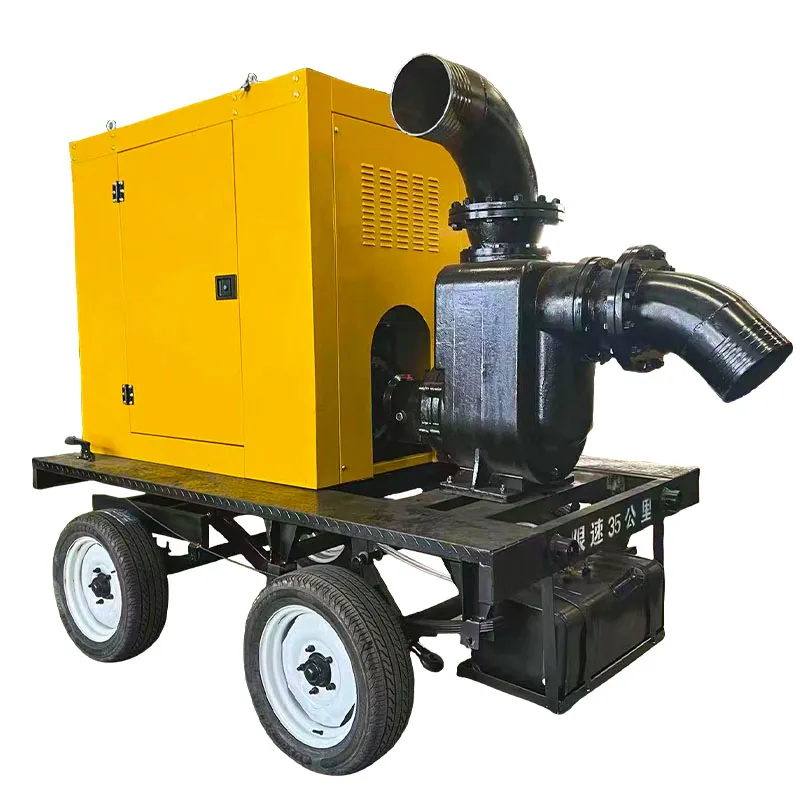
If we are not talking about a standard console pump, but, say, aboutself-priming pumpWith such a presentation, the story changes dramatically. The key parameter here is not only the flow, but also the suction height. A model that produces 60 m3/h when the line is full may “sag?” up to 40 or less if there is a need to rise from depth and remove air from the pipeline.
We tested such scenarios at our stand. It is important to understand that the self-priming design is a compromise. It is less efficient in terms of efficiency than a conventional centrifugal pump, but it solves the problem of airing. It should be chosen only when it is really necessary - for wells, drainage, where air leaks are possible.
Csubmersible pumpsanother task. For a well or tank with a supply of 60 m3/h, not only the pressure is important, but also the diameter of the housing so that it fits into a limited space. Often you have to go for a multi-stage design in order to get the required pressure in a narrow body. This is a more complex and expensive machine, but there may simply be no alternatives.
Installation and piping: where are those “cubic meters” lost?
It happens that you arrive at a site where they complain that the new pump does not produce the rated 60 m3/h. We open the passport - the model seems to be correct. You look at the harness - and everything is clear. At the suction there is a straight section of pipeline of two diameters instead of the recommended five to ten, followed by a sharp turn, then a sudden narrowing. The flow is swirling, uneven, the pump is operating with cavitation, what nominal flow can we talk about?
Proper tying is half the success. The suction must have a smooth supply, preferably straight run, and the shut-off valves must be full bore. Sometimes, to ensure a flow rate of 60 cubic meters per hour on the suction line, you have to install a pipe a size larger than the pump nozzle and make a smooth transition. It's a small thing, but it solves a lot of problems.
Another scourge is saving on check valves and gate valves. A cheap spring valve creates such resistance that the pump, especiallymultistage centrifugal pump, operating at high pressure, spends a significant part of the energy simply on opening it. It is better to install unstressed, rotary ones. Yes, more expensive. But the efficiency of the system as a whole will be higher, and the pump will not “knock” at start-up.
Experience and long-term perspective
In the end it's a choicecentrifugal pump 60 m3 h– this is not buying goods off the shelf. This is the design of a system node. At Zhejiang Yangzijiang Pumping Industry LLC, we try to structure the process so that the sales engineer first asks a dozen clarifying questions, and only then opens the catalog. Because supplying the wrong model means ruining the reputation and creating problems for the client.
Sometimes the correct solution is not one 60 pump, but two 30 pumps, operating alternately or in parallel. This gives flexibility and redundancy. Or, on the contrary, for a stable process without fluctuations - one powerful unit. It all depends on the task.
The main thing I learned from the experience is that there is no such thing as “just a pump”. There is a device that should become an organic part of the technological chain. And when it quietly, without vibration, pumps its 60 cubic meters per hour for years (or a little more, or less, depending on the needs of the system), then you understand that the selection was made correctly. And this is the ultimate goal of our work: for the equipment at the site to simply work, and not require constant attention.
Correspondingproducts
Related Products



Best Sellingproducts
Best Selling Products-
 Geared screw pumps type G
-
 Mechanical diaphragm dosing pumps DJ-D
-
 Horizontal multistage pumps for feeding DG boilers
-
 YCB Type Circular Gear Pumps
-
 Pipeline wastewater pumps GW
-
 YZZW Diesel self-priming pumps
-
 Single screw pumps type G
-
 QJ type borehole pumps
-
 Complete water supply installations with frequency regulation and constant pressure CDLF
-
 YZSP Diesel Self-Priming Pumps
-
 Liquid ring vacuum pumps type SKA and 2BV
-
 Metal electric diaphragm pumps DBY