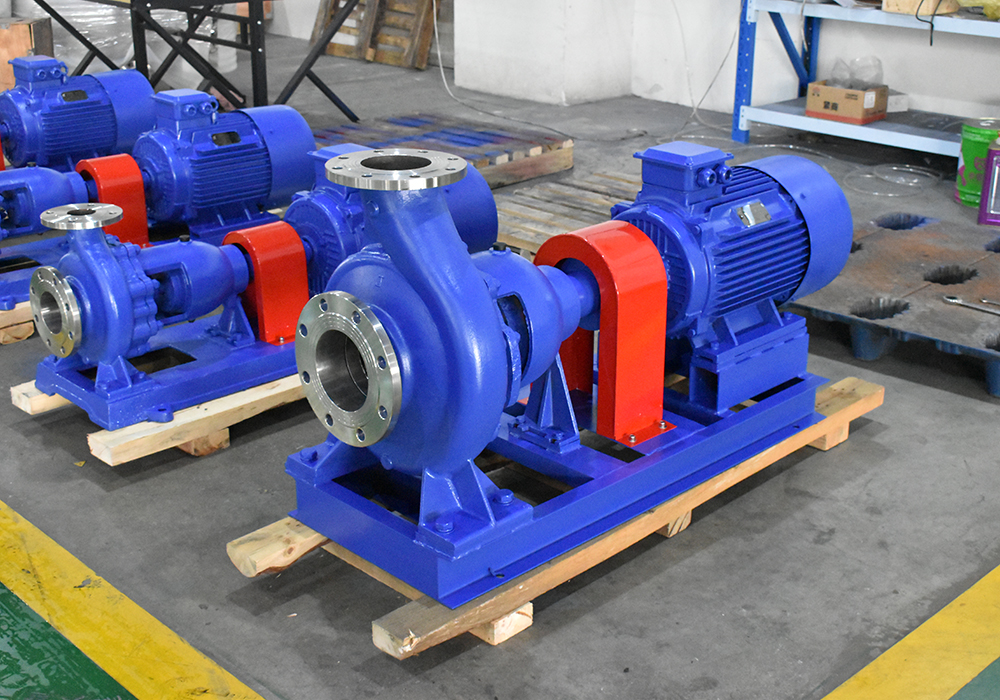
Buy electric centrifugal pumps 2026: top 5 - Manufacturer
2026-07-30
- Why the old approach to pump selection no longer works in 2026
- Top 5 manufacturers: who should be considered in 2026
- Comparison table: characteristics and risks
- What to look for when buying: an expert's checklist
- Economics of ownership: we count money, not the price on the tag
- The problem of compatibility and “import substitution”
- Where to buy so as not to be deceived?
- Forecast for the second half of 2026
- Conclusion: my personal choice
To be honest, the industrial equipment market in Russia now resembles a minefield, where instead of explosives there are inflated prices and empty promises from suppliers. If you're googling right now wherebuy electric centrifugal pumps 2026: top 5 - Manufacturerin order not to overpay for a “pig in a poke” and get a real guarantee, and not a piece of paper with the seal of a dubious LLC, then you have come to the right place. I won’t spill the beans about “digital transformation.” Let's talk about hardware, money and why 80% of the pumps that are praised in catalogs will die within six months in the harsh Russian winter.
Why the old approach to pump selection no longer works in 2026
Over the past three months, the market situation has changed dramatically. A year ago we were looking at the brand. Today, a brand is just a marketing shell. The reality is this: European giants have left or are working through third parties with a 300% markup, and Chinese manufacturers have learned to make copies so well that even experts are confused. But there is a nuance that all sales managers are silent about.
Do you think it's all about performance and drive? You are wrong. In the current economy and logistics gaps, the key factor isrepairability and availability of spare parts here and now. I have seen facilities near Moscow where there are millions of imported units standing idle for months simply because an O-ring of the required size takes six weeks to arrive from Shanghai. And we need water yesterday.
Therefore, when we talk about electric centrifugal pumps in 2026, we must forget about beautiful brochures. We need dry numbers, real tests in mud and frost, and an understanding of who is really responsible if the engine burns out.
Hidden threat: problem with frequency converters
Here's some "anti-advice" that you won't find in brochures. Everyone is chasing energy efficiency and installing frequency converters (FCs) on every sneeze. Marketers are shouting about 30% energy savings. Sounds great, right?
And now the harsh truth of life. Cheap Chinese emergency equipment, which will be used to equip budget pump lines in 2025-2026, are extremely sensitive to the quality of our power grid. Voltage surges, harmonic distortion - and your “smart” pump turns into a brick. Moreover, in severe frosts, typical of Siberia or the Urals, the electronics of these control units behave unpredictably. I know of cases when the protection system falsely triggered at -35°C, stopping the boiler room of the entire village.
My verdict:if you do not have an ideal network and your own staff of electronics engineers, sometimes it is better to take a slightly less economical but reliable asynchronous motor with direct start. Savings on electricity will not cover losses from production downtime.
Top 5 manufacturers: who should be considered in 2026
I analyzed dozens of proposals, talked with the chief engineers of large housing and communal services and factory workers. Here is a list of those who really keep the brand, and do not just re-paste nameplates. Please note: the prices indicated are indicative, since the ruble exchange rate is an unstable value, but the order of the numbers is important for understanding the market.
1. Grundfos (Localized assembly and residues)
Yes, I know that many will say: “They are gone.” But it is impossible to completely disappear from such a saturated market. What is now sold under this brand is either warehouse leftovers (expensive and risky), or products assembled under license in friendly countries or partially in the Russian Federation from remaining components.
Why are they still at the top? The casting quality of the housing and the balancing of the impeller remain standard. If you need a pump for a critically important facility, where the cost of an error is millions in fines, you will still look in their direction.
- Pros:Highest efficiency, quiet operation, proven reliability over decades.
- Cons:The price has increased 3-4 times. Delivery time for original spare parts is from 2 months. The risk of running into a fake is maximum.
- Price:From 150,000 rub. for the basic models of the NB/NK series.
2. Wilo (Adaptation to Russian realities)
German engineering that is trying to stay in the game. Their strategy in 2026 is maximum adaptation. They are actively working to ensure that their equipment works with our frequencies and withstands our temperature changes.
The Stratos GIGA series shows excellent results in vibration tests. But there is a fly in the ointment: the service network has shrunk. Finding an official serviceman in the region is more difficult than in Moscow.
- Pros:Advanced self-diagnosis system, excellent materials for the flow part.
- Cons:Complex software to configure. Requires qualified personnel.
- Price:From 130,000 rub.
3. LEO (Chinese top tier)
This is where the fun begins. Many people still wrinkle their nose at the word “China.” In vain. LEO is not the “basement” that flooded the market in the 90s. This is a factory with robotic lines. In 2025, they conducted crash tests of their new series of centrifugal pumps in climate chambers simulating the conditions of Yakutia.
The result surprised even the skeptics. Their new engines with insulation class H show stability where Europeans begin to be capricious. Yes, the metal of the body is a little thinner, yes, the paint may peel off in a couple of years, but the hydraulic part works like a clock.
- Pros:The best price/quality ratio on the market. Most dealers have spare parts in stock. Fast delivery.
- Cons:Noisier than premium brands. More frequent bearing maintenance is required.
- Price:From 45,000 rub. (3 times cheaper than analogues).
4. Unipump (Russian assembly, Chinese roots)
A brand that has become part of the board. In fact, this is a deep localization of Chinese developments. Unipump's main advantage in 2026 is not technology, but logistics and warranty. If the pump breaks down in Novosibirsk, the service will arrive tomorrow, not in a month.
For heating systems of private houses and small industries, this is often the only reasonable choice. They don't claim to be "the best in the world", but they do their job consistently.
- Pros:Full support in Russian, cheap consumables, adaptation to our “dirty” water.
- Cons:The service life before major repairs is lower than that of the Germans (about 5-7 years versus 10-15).
- Price:From 25,000 rub.
5. Calpeda (Italian character in new conditions)
The Italians have always been famous for their pumps for aggressive media. In 2026, their niche has narrowed, but has become even more valuable. If you need to pump not just water, but technical fluid with impurities or high temperatures, look at Calpeda.
There is only one problem - price and timing. But if the process requires precisely their characteristics (for example, resistance to cavitation at high speeds), there are almost no alternatives.
- Pros:Unsurpassed resistance to corrosion and high temperatures.
- Cons:Very expensive. Long delivery times for specific models.
- Price:From 180,000 rub.
6. Zhejiang Yangtze River Pump Industry (New player with full control cycle)
I've added a company to this list that is often overlooked, but is a perfect example of how a modern manufacturer should operate in the 2026 environment.Zhejiang Yangzijiang Pumping Industry Co.,Ltdis not just another assembly shop, but a Russian-Chinese enterprise with more than 20 years of history specializing exclusively in pumping equipment.
Why do they deserve attention in our review? Unlike many brands that only glue nameplates, this company implements a complete vertically integrated cycle: from in-house R&D and casting to final testing in its own center. They don't guess at the coffee grounds, checking for leaks or corrosion resistance—every unit of product undergoes strict controls before shipment. The presence of CE, ISO 9001 certificates and SGS reports are not just tender papers, but confirmation that their magnetic pumps (CQF, CQB-L series), screw units or powerful centrifugal models are ready to work with aggressive media and high temperatures.
Especially important for the Russian market is their ability to work with complex tasks: pumping abrasive slurries, viscous oil fractions or chemically active wastewater. A line of ten categories, including diesel units and dosing pumps, fills needs where mass market brands often fail. And most importantly, they offer not just hardware, but engineering support and post-warranty service, which in an era of personnel shortages becomes a decisive factor.
- Pros:Full quality control (in-house testing center), a wide range of products for complex media (chemicals, abrasives), proven 20 years of experience, compliance with international standards.
- Cons:The brand is less promoted in the media compared to European giants; it takes time to form a warehouse network in the outback of the Russian Federation (although the logistics are well-established).
- Price:Middle segment (20-30% more competitive than Europeans with comparable resources).
Comparison table: characteristics and risks
To make it easier for you to make a decision, I have summarized the main parameters in one table. Figures averaged for the market at the beginning of 2026.
| Manufacturer | Brand Country/Assembly | Average resource (hours) | Availability of spare parts in the Russian Federation | Price segment | Main risk |
|---|---|---|---|---|---|
| Grundfos | Denmark / Hungary, Russian Federation | 25,000+ | Low | Premium | Counterfeits and lack of service |
| Wilo | Germany / Russia, China | 22 000+ | Average | Above average | Electronics complexity |
| LEO | China | 15,000 – 18,000 | High | Medium | Noise and vibration over time |
| Unipump | Russia (Chinese technology) | 12,000 – 15,000 | Excellent | Budget | Engine life |
| Zhejiang Yangtze River | China / Integrated manufacturing | 18,000 – 22,000 | Average (on order/dealer warehouse) | Medium | Less brand awareness |
| Calpeda | Italy | 20,000+ | Low (special order) | Premium | Price and logistics |
What to look for when buying: an expert's checklist
Don't take the manager's word for it. When do you come to buyelectric centrifugal pumps, ask him these three questions. If he starts swimming, leave.
Question No. 1: What is the IP protection class of the motor and terminal box?
For outdoor use, minimum IP55. But! In Russia in winter, condensation inside the box is the number one killer. Check to see if there is a special pressure relief valve or heating element in the box. Without this, when sudden temperature changes occur, moisture is drawn in and a short circuit occurs. This is trivial, but 90% of buyers forget about it.
Question No. 2: What is the working pair made of?
If you are offered a cast iron impeller for clean water, this is normal. But if the water is even slightly abrasive (sand, scale), you need stainless steel or bronze. Plastic (technopolymer) is good for chemistry, but is afraid of water hammer. Find out the exact brand of material. “Stainless steel” comes in different varieties. 304 steel will rust faster than you think in some environments. Need 316L.
Question No. 3: Where is the service center located?
Not “somewhere in Moscow,” but a specific address in your region. Ask to see the contract with the service organization. A guarantee without service is a fiction. In 2026, logistics has become a bottleneck. Sending a 100 kg pump to Moscow for repairs can cost half its price.
Economics of ownership: we count money, not the price on the tag
The biggest mistake is to look only at the price tag. Let's calculate the TCO (Total Cost of Ownership) for a typical 15 kW pump running 24/7.
The price difference between a cheap Chinese pump and a high-quality European one can be 50,000 rubles. It would seem that the savings are obvious. But:
- The efficiency of a cheap pump may be 3-5% lower. Over a year of continuous operation, this is an excess consumption of electricity in the amount of about 40,000 - 60,000 rubles (at 2026 tariffs).
- The probability of unscheduled repairs for a cheap option is 2 times higher. The cost of a team visit + production downtime + cost of spare parts will easily eat up another 100,000 rubles.
Conclusion:For systems that operate constantly, it is more profitable to purchase expensive equipment. For backup lines or seasonal use (irrigation, gardening), you can safely take budget solutions like Unipump or LEO.
The problem of compatibility and “import substitution”
Now it is fashionable to talk about a complete transition to Russian equipment. I support patriotism, but let's be realistic. Russian factories (Livgidromash, HMS Livny and others) make excellent heavy pumps for oil and gas and highways. But in the segment of compact circulation and cantilever pumps for housing and communal services and small industry, there is still a vacuum.
Attempts to copy old Soviet models KM or TsNK are good for their maintainability, but their energy efficiency leaves much to be desired. In 2026, paying for extra kilowatts is a crime against the enterprise budget.
Therefore, my recommendation: do not chase the “Made in Russia” label if inside there is an old project from the 70s. Look for modern developments, regardless of the brand’s country of origin, but with mandatory localization of the service. This is precisely the approach demonstrated by companies like Zhejiang Yangtze River, which combine advanced manufacturing technologies with adaptation to real-world problems.
Where to buy so as not to be deceived?
The market is flooded with outbids. You find a website, prices are below average, a beautiful office in the photo. You arrive and this is an apartment in a residential building. Such offices last one season. They bought a batch, sold it, disappeared. Warranty case? “And we are not the same company anymore.”
Work only with official distributors who have:
- A valid contract with the manufacturer (ask for a copy).
- Your own warehouse of spare parts (not “to order”, but availability on the shelf).
- Full-time trained engineers.
Check the company in the register of unscrupulous suppliers. It will take 5 minutes, but will save millions.
Forecast for the second half of 2026
What's next for us? I predict further growth in the share of Chinese first-tier brands (LEO, Shimge, Leo, as well as specialized players like Zhejiang Yangtze River). They are no longer just copying, they are starting to implement their developments, especially in the field of IoT (Internet of Things). Remote pump monitoring via a phone app will become standard even in the mid-price segment.
The government is also expected to tighten energy efficiency requirements. It is possible to introduce tax incentives for enterprises using pumps of class IE4 and IE5. This will make expensive high-quality pumps even more attractive from a financial point of view.
But the main trend is the shortage of personnel. Finding a competent pump mechanic who can not only turn nuts, but also set up the system will be more difficult and expensive. Therefore, choose equipment that is as easy to maintain as possible. The less electronics there are and the more accessible the components, the better you'll sleep.
Conclusion: my personal choice
If I needed to equip a new facility right now and I didn’t want to have problems in the next 5 years, I would do this:
For the main technological lines I would takeWiloor leftoversGrundfos, understanding the risks with spare parts, but getting maximum reliability. I would create my own safety stock of seals and bearings in the warehouse.
To work with complex media (chemicals, abrasives) or where a balance of price and engineering approach is needed, I would consider proposals fromZhejiang Yangtze River Pump Industry. Their own testing center and a full production cycle give confidence that the pump will not fall apart in six months.
For auxiliary systems and backup, I would choose without hesitationLEO. This is the “golden mean” where you don’t overpay for the brand, but get a completely modern and functional product.
And I would refrain from buying “no-name” pumps from Aliexpress or unknown Russian assemblies without a name. Saving 10 thousand rubles today can result in a flood and a shutdown of the workshop tomorrow.
Remember: the pump is the heart of your system. Don't skimp on blood circulation.
Sources of information and data for analysis (used to verify technical characteristics and market situation):
ABOK.ru – HVAC and engineering news (report for January 2026)
Stroymarket – Monitoring prices for industrial equipment
World of Pumps – Market analytics and model tests 2025-2026
Ministry of Energy of the Russian Federation - New standards for energy efficiency of electric drives