Operating Precautions and Design Principles of Type G Horizontal Single Screw Pumps
2026-01-20
The G-type single screw pump is a positive displacement rotary pump that pumps liquids by creating volumetric changes in the suction and discharge chambers through the interaction of the screw and bushing. Proper operation of G-type single screw pumps not only extends their service life, but also reduces production costs for enterprises. Why not take advantage of this? The question then arises: how to properly operate G-type single screw pumps and what precautions should be taken? Let's look at it together below.
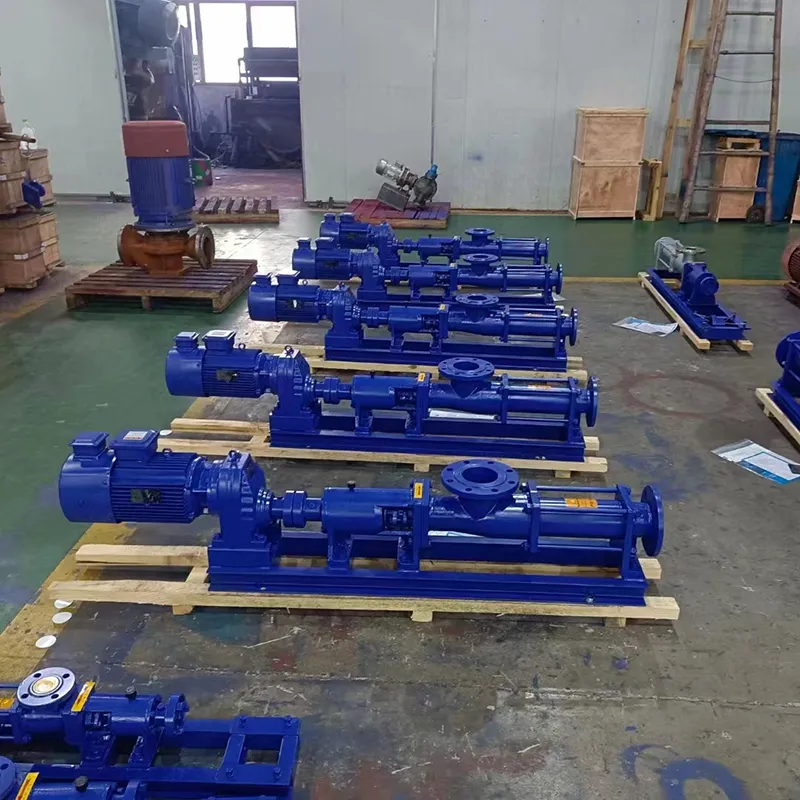
Precautions for using G type single screw pumps
Before starting the G-type screw pump:
1.Make sure the flow process is correct.
2.Ensure that the pump's surroundings are clean and free of obstructions that could interfere with operation.
3.Check that the screws on the coupling guard, supports and other components are securely fastened by checking for play.
4.There must be enough lubricating oil in the bearing oil reservoir. The oil level must be maintained within the specified range and the oil quality must be good.
5.Select a suitable pressure gauge according to the application and performance of the pump.
6.For pumps equipped with bearing or shaft seal cooling systems, ensure that water flow is not obstructed.
7.Check that the voltage is within the specified range and the external motor wiring and ground are in good condition.
8.Rotate the coupling by hand to check for foreign objects, unusual noises, or seizing inside the pump and correct any problems found.
Starting and operating screw pumps type G:
1.Fill the pump chamber with liquid material; dry work is strictly prohibited.
2.After opening the inlet and outlet valves of the G-type single screw pump (the valves must be fully open to prevent overload or cavitation), start the engine.
3.If a bypass valve is installed, run the pump with the inlet and outlet valves fully open along with the bypass valve. Allow the pump to run under this load until the drive motor reaches rated speed, then gradually close the bypass valve.
4. During operation, check the integrity of the shaft seal. Drip seepage is allowed; Minor leakage from the shaft seal is acceptable. A leak rate not exceeding 20-30 seconds per drop is considered normal. Make sure the pump discharge volume is correct and watch for vibration or noise. If any abnormality is detected, stop the pump immediately and correct the problem.
Stopping the pump:
Before stopping the pump, first stop the engine. Then close the suction pipe valve and then the discharge outlet valve (to prevent dry running and avoid scratching work surfaces).
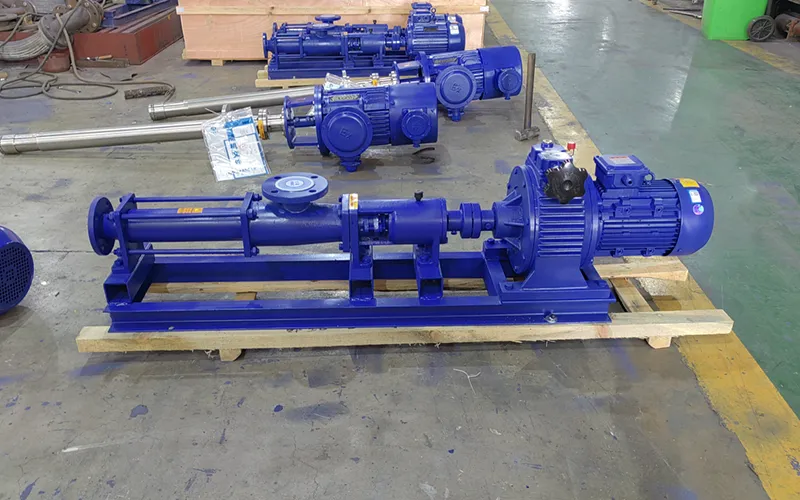
Precautions for using G-type progressive cavity pumps
1.Before starting, fully open the intake and exhaust valves. After opening the outlet valve, start operating the pump immediately. Never run the pump with the outlet valve closed (if the outlet valve is closed, make sure the inlet and outlet bypass valves are fully open).
2.When process flow requirements are low, the outlet valve can be partially or completely closed. At the same time, fully open the inlet/outlet bypass valve. Once normal pump operation is established, gradually open the outlet valve according to process requirements while closing the bypass valve to normal operating conditions.
3. Long-term operation without priming the pump is prohibited.
4.Stop operation immediately under any of the following conditions: severe leakage, abnormal vibration, unusual odors, sparks, smoke, impact noises, or continuous excess current.
5. During operation of G type screw pumps, the bearing temperature should not exceed the ambient temperature by more than 35 °C and should not exceed 80 °C.
6.Flow and pressure should remain stable, and current should not exceed the rated values.
7.Seal leakage should not exceed the following requirements:
7.1 Mechanical seals: heavy oil ≤ 5 drops/min; light oil ≤ 10 drops/min.
7.2 Oil seals: heavy oil ≤ 10 drops/min; light oil ≤ 20 drops/min.
8.Make sure that no foreign objects get into the pump housing. Solid contaminants in wet sludge can damage the rubber stator of the screw pump. Therefore, it is very important to prevent such a hit. Many wastewater treatment plants install grinders in front of the pump, while others use screens or screens to block debris. Grates need to be cleaned regularly to prevent blockages.
9.Prevent material shortage. Never allow G screw pumps to operate without material being supplied. In this case, the rubber stator will burn out instantly due to dry friction causing high heat. Therefore, it is necessary to maintain full operation of the shredder and for normal operation it is necessary that the screens are clean and not clogged. To combat this problem, some progressive cavity pumps are equipped with a flow cut-off device located on the pump body. When the material supply stops, the self-priming ability of the pump creates a vacuum in the chamber, which causes the vacuum device to operate and stop the G screw pump.
Having looked at the safety precautions for using G-type single screw pumps, we will now look at the typical faults associated with these units.
Design and operating principle of G type horizontal single screw pump
The G-type single screw pump is a positive displacement rotary pump that pumps liquid by varying the volume in the suction and discharge chambers through the interaction of the screw and bushing. This sealed internal gear screw pump consists of a dual helix bushing (stator) and a single helix screw (rotor) that meshes within the stator cavity. When the input shaft drives the rotor, which performs planetary rotation around the center of the stator through a universal joint, the stator-rotor pair interacts continuously to form sealed chambers. These chambers are subject to constant volumetric uniform axial motion, transporting the medium from the suction end through the stator-rotor pair to the discharge end. The fluid drawn into the sealed chamber flows through the stator without mixing or disturbance.
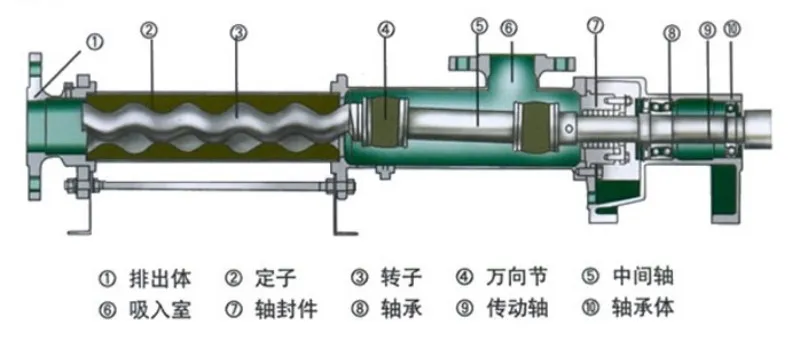
Diagram of the internal structure of a horizontal single screw pump type G
The inner surface of the sleeve has a double thread, with each cross section forming an elongated ellipse. Both ends consist of semicircles of radius R (equal to the cross-sectional radius of the screw), and the central part consists of a straight segment of length 4e. Each cross section of the bushing is an identical elongated ellipse, offset relative to each other by an angle.
When a screw is inserted into a sleeve, sealed chambers are formed between the surface of the screw and the internal threaded surface of the sleeve. At the same time, each cross section is divided into upper and lower working chambers in the shape of a crescent. As the screw rotates, the volume of the chamber adjacent to the suction chamber gradually increases, creating negative pressure. Under the influence of a pressure difference, liquid is sucked into this chamber. As the screw rotates further, the volume of the working chamber steadily increases until it becomes sealed, pushing the liquid axially towards the discharge chamber. At the same time, the upper and lower working chambers alternately undergo suction and discharge cycles, thereby continuously moving the liquid in the axial direction from the suction chamber to the discharge chamber.
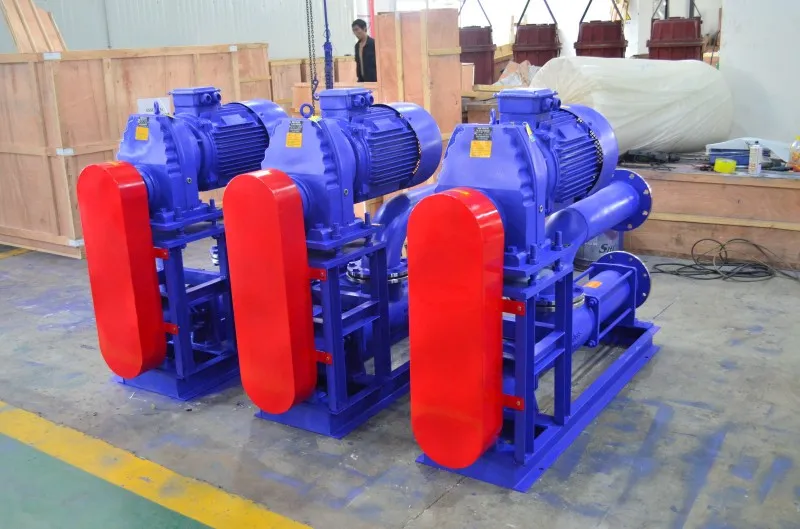
The above has described the safety precautions for operating G-type single screw pumps and introduced the design principles of horizontal single screw pumps. Single screw pumps have been demonstrated to have exceptional adaptability to a variety of media, provide consistent flow rates with minimal pressure pulsation, and have superior self-priming capabilities - qualities that no other type of pump can boast. In addition, single screw pumps play an indispensable role in the transport of highly viscous materials.