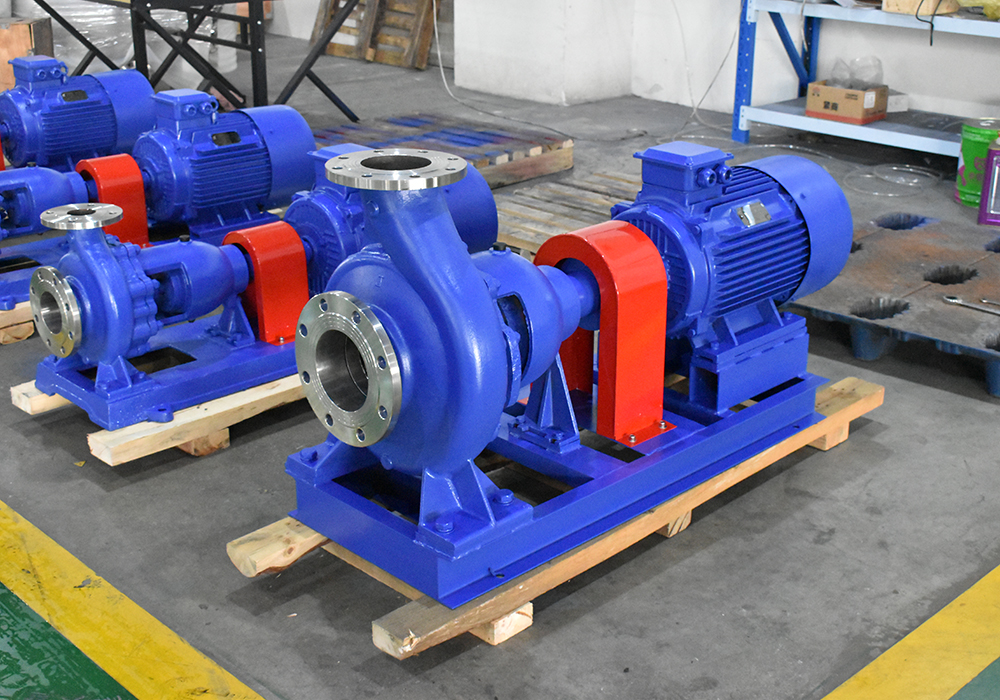
China centrifugal pump for pipe buy - Factory
2026-08-04
- Why the old approach to pump selection no longer works in 2026
- The Real Cost of Ownership: Where Your Money Is Hiding
- How to choose a reliable manufacturing plant in the current conditions
- Practical guide: step-by-step purchasing algorithm without errors
- Forecast: what awaits the pump market in the next two years
You were looking for wherebuy a centrifugal pump for a pipedirect from the factory, but tired of catalogs that look like they were written in 2015? Let's be honest: the industrial equipment market in Russia is now going through such a storm that the old advice about the “reliability of German brands” sounds like a mockery. I've spent the last three months visiting warehouses from Yekaterinburg to the outskirts of Moscow, and what I saw made me rewrite this article three times. If you need not just a piece of cast iron with an impeller, but a solution that will not freeze on the first night of January and will not ruin your budget due to the euro exchange rate, you have come to the right place. There is no marketing fluff here, only dry numbers, real prices for 2026 and a little bit of the bitter truth about what sellers are hiding.
Why the old approach to pump selection no longer works in 2026
Forget what you read in textbooks from five years ago. The world has changed. Previously, an engineer would come to a factory, point his finger at a Grundfos or Wilo catalog and leave satisfied. Today? Today this catalog may be empty, and if there is a product, then its price causes a nervous tic. The Russian pumping equipment market has become a testing ground for an incredible experiment: what will happen when the Western giants leave and Chinese factories begin churning out products under Russian brands?
The situation is paradoxical. On the one hand, there is a shortage. On the other hand, there is an oversaturation of incomprehensible “no names”. When you enter a querybuy a centrifugal pump for a pipe, algorithms give you hundreds of offers. But 80% of them are resellers who don’t even know the technical characteristics of what they are selling. They simply resell containers from Guangzhou with a 300% markup. Factories? Real factories with their own casting and assembly can be counted on the fingers of one hand, and even those often work at the limit of their capabilities.
I'm worried about one detail that all sales managers are silent about. Metal quality. In pursuit of import substitution, some domestic manufacturers (yes, the same ones whose logos you see on every second facility) began to use cast iron of lower grades. Externally, the pump looks identical to its Soviet or European counterpart. But after two years of operation in an aggressive environment, it begins to “float”. Corrosion is eating away at the body faster than planned. This is not a theory, this is what I had to deal with when auditing one large water utility in the Moscow region.
The Chinese factor: salvation or new dependence?
Let's talk about the elephant in the room. China. Now the phrase “Chinese pump” no longer causes such rejection as it did five years ago. And it's not just about the price. Chinese engineers have learned to do things that were previously considered the prerogative of Europe. Take, for example, a series of vertical multistage pumps. In 2024–2025, leading Chinese concerns like Leo or Shimge carried out a deep modernization of the hydraulic part. They introduced new impeller alloys that are resistant to cavitation.
However, there is a nuance that can be fatal for your business. Electric motor. Often the pump unit itself is high-quality China or even assembled in the Russian Federation, but the engine... It’s a lottery. In cheap segments, they can supply you with a motor with energy efficiency class IE1, when the whole world has long switched to IE3 and IE4. In the context of constantly rising electricity tariffs in Russia, this is deadly for operating costs. You will save 15 thousand rubles upon purchase, but will lose a million in three years on electricity bills.
I personally tested a couple of models declared as “a complete analogue of European standards.” On paper everything is beautiful: efficiency 78%, head 50 meters. In practice, when connected to a real network with voltage sags, which are not uncommon in industrial areas, the frequency converter (if built-in) began to fail. Chinese electronics are sometimes not ready for our “peculiarities” of power supply. Therefore, my advice: if you take China, look not at the sticker, but at the filling. Require a passport for the engine separately.
The Real Cost of Ownership: Where Your Money Is Hiding
When you're looking for wherebuy a centrifugal pump for a pipe, you look at the price tag. This is a rookie mistake. A professional looks at TCO (Total Cost of Ownership) - the total cost of ownership. Let's look at specific examples of what is happening in the market right now, at the beginning of 2026.
Prices are jumping. Not linearly, but in jerks. The yuan exchange rate, logistics through Kazakhstan or direct sea routes - all this affects the final figure. But there is also internal production inflation. Castings have become more expensive, energy prices have risen. What do we have in the bottom line?
Let's take the popular segment of type K console pumps (or their modern analogues). Just two years ago, a good copy could be found for 45–50 thousand rubles. Today the normal price starts from 85 thousand and goes for 120 thousand if it is a brand with a name and a guarantee. Cheaper? Please. But be prepared for the seals to leak after six months, and the bearings to hum after the first winter.
And now about the service. This is where the main problem lies. Buying is easy. It's difficult to fix. Spare parts for European pumps have become a luxury. The delivery time for a mechanical seal for an old Grundfos can be up to 4–6 months. Some companies have learned to do reverse engineering and produce analogues, but the accuracy of the geometry is not always ideal. Chinese parts are available faster, but their quality varies from batch to batch.
Therefore, when choosing a supplier (factory or dealer), ask one simple question: “Do you have a warehouse of running spare parts here in Russia?” If the manager starts mumbling about “fast delivery from abroad,” turn around and leave. You need details here and now. Downtime of a water supply or heating system at an enterprise costs more than any pump.
Technical pitfalls when installing on a pipeline
It would seem that it’s so difficult? I screwed the flanges on, turned it on, and it works. No matter how it is. I've seen so many improperly installed pumps I could write a dissertation on it. The most common mistake is ignoring cavitation. People buy a powerful pump to “have some extra” and put it on suction with a long pipe and a bunch of elbows. Result? The pump howls, vibrates and destroys itself within a few months.
This is especially true for systems operating with hot water or chemically active liquids. In Russian realities, when pipes are often laid outdoors or in unheated rooms, the issue of thermal insulation and frost protection is acute. Many modern models have sensitive electronics in the terminal box. If the box does not have proper protection (IP55 minimum, or better IP65) and is heated only by the engine, in cold weather of -30°C condensation inside can cause a short circuit.
Another point that is rarely written about in instructions is the vibration load on the pipeline. The centrifugal pump creates pulsations. If your pipe system is old, metal, without proper expansion joints and flexible inserts, this vibration will be transmitted further. Within a year, you'll find cracked welds or loose flange joints somewhere hard to reach. Installing rubber expansion joints at the inlet and outlet of the pump is not an option, it is a mandatory requirement for the long life of the entire system.
| Parameter | Budget segment (China/Russian economy) | Premium segment (Remaining Europe/Top China) | Soviet legacy (used or remanufactured) |
|---|---|---|---|
| Price (average) | 40,000 – 90,000 rub. | 150,000 – 400,000+ rub. | 30,000 – 70,000 rub. |
| Delivery time | 2–4 weeks (from Russian warehouse) | From 1 day to 3 months (on order) | Availability is unpredictable |
| Energy efficiency | Often IE1/IE2 | IE3 / IE4 (with frequency drive) | Low (outdated standards) |
| Availability of spare parts | High (universal) | Low (long logistics) | Medium (much interchangeable) |
| Risk of failure | Medium (depends on batch) | Low | High (resource wear) |
How to choose a reliable manufacturing plant in the current conditions
You want to buy directly from the factory. This is the right desire, allowing you to cut down the markups of intermediaries. But how to distinguish a real factory from a “garage assembly” that simply glues beautiful nameplates? In Russia, it is now fashionable to register trademarks and locate production in China, passing it off as a “Russian-German joint venture” with an address in some business center in Moscow.
First rule: ask for a tour or video tour of the production facility. Not in the office, but in the workshop. You should be interested in three areas: the foundry (if they cast the cases themselves), the machining area (CNC machines) and the test bench. If the plant does not have its own test bench, where each pump is tested under load before shipment, run away from there. Such “manufacturers” simply assemble construction kits from purchased components, and quality control is lame.
It is the presence of a full-fledged testing center that becomes the filter that separates the wheat from the chaff. An example of a serious approach isZhejiang Yangzijiang Pumping Industry Co.,Ltd. This is a Russian-Chinese enterprise with more than 20 years of history, which not only declares quality, but confirms it with infrastructure. Their manufacturing base in Zhejiang Province includes eight complete lines and an in-house testing center where each product - be it a centrifugal, magnetic or screw pump - is tested for performance, leak-proofness and corrosion resistance. This is a rare case where a company operates as an integrated organization, from R&D to after-sales service, with CE, ISO 9001 and SGS certifications. When you see similar documents and a real history of projects with international groups (such as APP or DALI) from a supplier, the likelihood of getting a “pig in a poke” tends to zero.
Second rule: look at the brand history in the register of patents and certificates. This plant has certificates of conformity with TR CU (Technical Regulations of the Customs Union). Please note the date of issue and certification authority. Counterfeits can also be found here, but checking the certificate number in the unified register of the Russian Accreditation Service is a matter of five minutes.
The third, most important point is the presence of a service engineering department. The plant, which is confident in its product, has a network of authorized service centers throughout the country. Try calling their service in your area. If the phone does not answer or the technician says that “you have to wait six months for parts from the head office,” this is a red flag. For industrial equipment, support should be local.
Specifics of work in Russian climatic zones
Russia is a country of contrasts. What works great in Krasnodar will die in Norilsk. When choosing a centrifugal pump for installation on a pipe, be sure to take into account the climatic version. Standard version U3 (temperate climate) is suitable for most rooms with heating. But if the pump is installed outdoors, in an unheated pavilion or in an area with extreme temperatures, you need a HL (cold-resistant) design.
What's the difference? In materials. Ordinary cast iron becomes brittle in severe frost. A blow and the body cracked. The cold-resistant version uses special frost-resistant cast iron or steel. The lubricants in the bearings also differ. Ordinary Litol-24 freezes in the cold, turning into stone, and the bearing jams in a matter of minutes of operation. Special frost-resistant lubricants retain fluidity down to -50°C and below.
Do not forget about electrical heating of terminal boxes. In the northern regions this is a mandatory option. Many factories offer it as an additional option. equipment, but are often forgotten to be included in the basic package. Please check this point in advance. It’s better to overpay 5 thousand rubles for a heater now than to change a burnt-out motor winding in the spring.
Practical guide: step-by-step purchasing algorithm without errors
Let's structure the process so that you don't get drowned in the flow of information. Here is my personal checklist that I use when purchasing for large projects.
- Step 1. Audit the task.Don't blindly believe design data from ten years ago. Actual flow and pressure may vary. Measure the parameters of your system yourself or order an audit. An error in selecting power leads either to excessive energy consumption or to the inability to pump the required volume.
- Step 2. Filtering suppliers.Make a list of 5-7 potential factories. Weed out those who do not have a website with current contacts, who do not provide technical data sheets in the public domain, or whose reviews in professional communities (not on their website!) are questionable. Look for those who boast a wide range of products - from magnetic pumps for aggressive environments to diesel units, as serious market players do.
- Step 3. Request for a commercial proposal (CP).In your request, indicate not only the model, but also the requirements for warranty, delivery time and availability of spare parts. Ask to break down the price: pump, motor, frame, coupling, control cabinet. Often a “low price” is achieved by eliminating the control cabinet or frame, which then has to be purchased separately at an inflated price.
- Step 4. Checking for lice.Call the service department of the selected plant. Ask a tricky question: “What happens if my shaft fails in a month? What is the replacement procedure? The answer will show their level of customer focus.
- Step 5. Contract and guarantee.Read the warranty clauses carefully. Factories often decline responsibility if the installation was not carried out by their specialists. Try to insist on supervision of installation or at least consultation with their engineer during commissioning.
Where to look for the best deals in 2026?
The market has consolidated. Large players have become even larger, small ones have either closed or gone into a niche. If you need a small pump for a private home or small production, it makes sense to look towards federal networks of construction equipment that work directly with Chinese factories under their own brand. There is a lower risk of running into an outright marriage, since the network values its reputation.
For industrial scale - only a direct contract with the plant. The main production clusters are located in the Volga region (Tatarstan, Samara region), in the Urals and in the Leningrad region. Casting and heavy mechanics capacities are concentrated there. Feel free to go there in person. A personal meeting with the chief engineer or sales director often resolves issues that have been hanging in correspondence for months.
It is also worth monitoring government procurement and tenders. Sometimes factories offer surplus products or batches with minor cosmetic defects (that do not affect performance) at prices significantly lower than market prices. This is a great way to save money if you are willing to accept an item with a scratch on the case for a significant discount.
Forecast: what awaits the pump market in the next two years
Let me make a forecast based on current trends. The era of “simple iron pumps” is ending. The future belongs to smart systems. Already, more and more factories are offering pumps with built-in IoT sensors. They transmit data on vibration, bearing temperatures and current consumption directly to the cloud or control room. This allows you to predict breakdowns before they occur.
In Russia, this trend will intensify due to a shortage of qualified personnel. It’s easier to install a monitoring system than to have a staff of mechanics who run around listening to the pumps. However, along with convenience comes a new headache - cybersecurity and software compatibility. Are your systems ready to receive data from your new smart pump? This question needs to be asked today.
Prices, unfortunately, are not expected to stabilize. Raw materials are becoming more expensive, logistics are becoming more complicated. The only way to fix a favorable price is to enter into long-term contracts with factories or purchase pro stock equipment if working capital allows. Waiting for “better times” in the current economic reality is a losing strategy.
And one last thing. Don't chase a brand for the sake of a brand. A Soviet pump, restored at a good factory with all components replaced with modern analogues, often serves better than a new “Chinese” from the cheapest line. The engineering thought of those years was focused on reliability and maintainability, which is so lacking in modern disposable products. The golden mean is modern Russian developments or proven international production (such as the full-cycle control enterprises mentioned above), using proven hydraulic circuits, but equipped with new materials and energy-efficient engines.
Buying a centrifugal pump is an investment. It's expensive to make a mistake here. But if you approach the issue head-on, filter out the marketing noise and look at the facts, you can find a great solution that will last for decades. I hope this material saved you time, money and nerves. Good luck in your choice, and may your pipes never experience pressure problems!