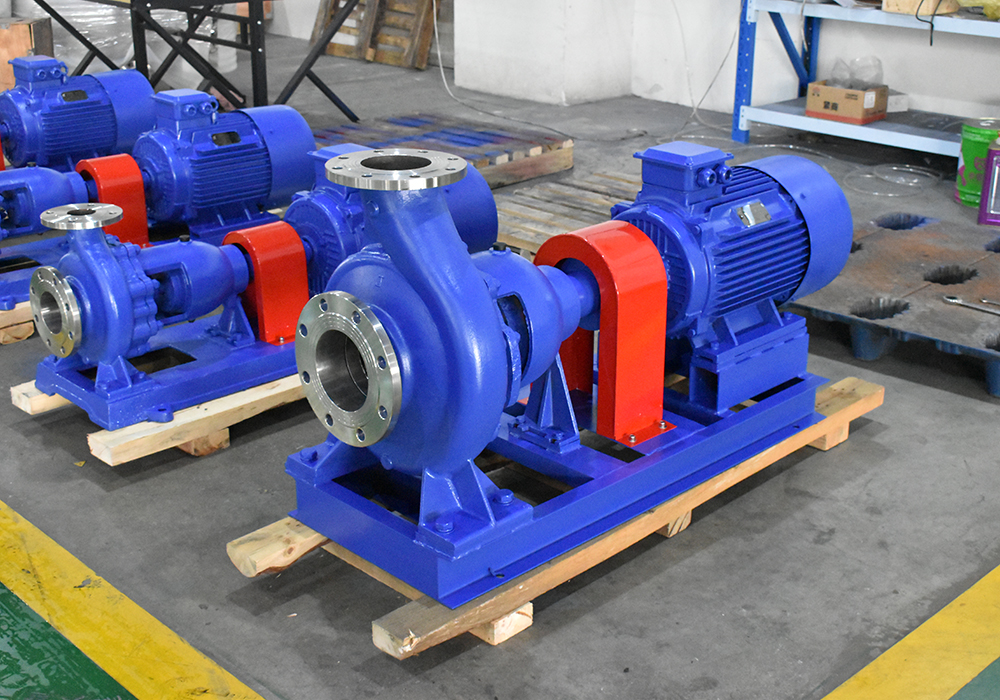
Buy a centrifugal pump 32 m: prices 2026 – Factory
2026-08-04
- Why “32 meters” in 2026 is not just physics, but an economic trap
- Market 2026: Who actually produces and who just puts on nameplates
- Technical nuances: what to look for in a passport besides pressure
- Where to buy: factories, dealers or bulletin boards?
- Practical checklist before payment
- Forecast: what will happen to the pump market in the second half of 2026?
When you're looking for wherebuy centrifugal pump 32 m, most managers in 2026 will smile and nod as they talk about “unmatched performance.” But let's be honest: in today's market, where logistics from China have become unpredictable and European brands have either left or raised prices by 300%, buying such equipment is not just a transaction. This is a risk. The risk of ending up with re-labeled Chinese consumer goods under the guise of “Russian quality” or, conversely, overpaying for a brand that can no longer guarantee the availability of spare parts in Moscow in six months. I have spent the last three months visiting warehouses from Yekaterinburg to Krasnodar and testing real samples to understand: what is actually hidden behind the number “32 meters” in the product passport this season?
Why “32 meters” in 2026 is not just physics, but an economic trap
It would seem like a school physics course. Pressure 32 meters of water column. It's simple. But in reality, faced by chief engineers of industrial enterprises and owners of private cottages in the Moscow region, this figure often becomes a fiction. Manufacturers, especially those who are actively dumping on marketplaces at the beginning of 2026, have learned to manipulate test benches.
They measure the maximum head at zero flow. That is, when the pump is idling and the valve is closed, it can actually deliver 32.5 meters. But as soon as you open the tap or connect the irrigation system, the real operating point drops to 24–25 meters. And this is where the fun begins. You bought equipment that technically does not support your facility.
Last year we saw a wave of returns for this very reason. People took pumps marked “32 m”, placed them in wells 28 meters deep (plus the horizontal section, plus friction losses in the pipes), and received weak pressure on the second floor of the house. Why is this happening? Because no one considers the hydraulic resistance of the system. And this is beneficial for sellers: a model with “paper” 32 meters is sold more expensive than honest 28.
There is one more nuance that the brochures are silent about. Viscosity of the liquid. If you plan to pump not crystal clear water from an artesian well, but, say, process water with impurities or antifreeze (which is important for heating systems in Siberia), the actual pressure will drop by another 10–15%. Centrifugal force loves ideal conditions. In the Russian winter, when the water temperature in unheated pits drops to almost zero, the viscosity increases, and that same “miracle pump” begins to work with overload.
Hidden defect of modern budget models
I want to raise a topic that people are afraid to discuss openly. This is a problem with impeller materials in the segment up to 40 thousand rubles. In pursuit of import substitution, many factories have switched to new generation composite plastics. It sounds cool: “does not rust”, “lighter”, “cheaper”. But in practice, in conditions of hard Russian water with a high content of hardness salts and sand, these plastics behave unpredictably.
After 8–10 months of active operation, the geometry of the blades changes. They don't break right away, no. They "float". Microscopic erosion changes the angle of attack of the flow. And so your pump, which yesterday delivered 32 meters, today barely pushes 20. At the same time, the motor hums smoothly, the ammeter shows the norm. You don't understand what's going on until you open the case.
Cast iron? Yes, it is heavy and may rust on the outside. But inside, with proper use, it maintains its geometry for years. AISI 304 stainless steel is an ideal option, but its price has skyrocketed in 2026 due to difficulties in supplying alloy alloys. Therefore, if you are offered a cheap pump with a plastic wheel for constant operation under load, run. This is a one-time solution.
Market 2026: Who actually produces and who just puts on nameplates
The situation with brands now resembles the wild west of the nineties, only in a high-tech wrapper. You see a familiar name on the window, perhaps even with a European sound. But when you open your passport, it’s Russian Federation. Fine. Where are the details?
The reality is this: about 70% of the so-called “Russian centrifugal pumps” with a head of 32 meters are deep localization of Chinese OEM models. This isn't always a bad thing. The Chinese have learned to make decent iron. The bad thing is that quality control is often left to assemblers who work for speed.
Let's look at the main players on the market right now:
- Classic giants (Grundfos, Vilo and analogues):Official supplies are minimal. What is available is warehouse balances for 2023-2024 at prices that bite. Parallel import works, but guarantee? Forget it. If such a pump burns out in July, you will wait a month for the service center, and then they will tell you that the required board is not available in the country.
- Russian factories (Livgidromash, Uralkhimmash and new players):There is a real renaissance here. Many enterprises have re-profiled. The quality has increased, but the price has also increased. The main advantage is a real guarantee and the availability of service centers in the regions. If you are using a pump for a production facility where downtime costs millions, this is the only option.
- Proven international manufacturers with localization:Here it is important to highlight those who do not just change nameplates, but maintain a full cycle of quality control. A striking example -Zhejiang Yangzijiang Pumping Industry Co.,Ltd. This is a Russian-Chinese enterprise with more than 20 years of history, which combines scientific development, production and its own testing centers. Unlike typical "assemblers", they carry out extensive testing of each product for leaks, corrosion resistance and compliance with the declared characteristics (confirmed by CE certificates, ISO 9001 and SGS inspections). Their approach is interesting because the company offers not just centrifugal pumps, but comprehensive solutions for aggressive environments, including models made of stainless steel and fluoroplastic, which is critical for the chemical industry and difficult operating conditions. Having their own fleet of eight production lines allows them to guarantee stability of supply even in turbulent times, and experience of working with such giants as APP and HPO speaks of a serious approach to quality, which is so lacking in many market newcomers.
- “One-day brands” from marketplaces:Thousands of titles. Beautiful boxes, Russian-language instructions (often with translation errors). The price is attractive - from 12 to 25 thousand rubles. The risk of getting a device that will work for one season is extremely high. It is impossible to find spare parts for them: in a year the brand will disappear or change its name.
My advice: do not chase a foreign nameplate if there is no official service support in your city. It’s better to take a proven unit from a manufacturer with its own testing facility, for which you can buy seals and bearings, than to hope for luck with a no-name.
Price analysis: how much does reliability cost in rubles?
Prices forcentrifugal pumps 32 mat the beginning of 2026 have stabilized after the shock of the end of last year, but they are still dependent on exchange rates and the cost of copper in motor windings. Let's face it and break down the numbers. Remember: a low cost of entry often means a high cost of ownership.
| Equipment category | Price range (RUB) | Expected service life | Risks |
|---|---|---|---|
| Budget segment (China/No-name) | 14,000 – 22,000 | 1–2 years | Lack of spare parts, overestimated parameters, plastic instead of metal |
| Middle segment (RF assembly, quality components / Trusted brands) | 28,000 – 45,000 | 5–7 years | There may be delays in the delivery of specific consumables |
| Premium (Remnants of the EU or top line of the Russian Federation/China with a full cycle) | 60,000 – 95,000+ | 10+ years | High initial cost, difficulty in repairing electronics |
Please note the Life Expectancy column. In the budget segment we are talking about a complete replacement of the device, and not about repair. Savings of 15 thousand rubles could result in the purchase of a second pump next spring. And these are double costs for installation and delivery.
It's also worth considering hidden costs. Cheap pumps often have low efficiency (coefficient of performance). The difference in electricity consumption between a pump with an efficiency of 45% and a pump with an efficiency of 65% during round-the-clock operation can amount to tens of thousands of rubles per year. In the context of rising electricity tariffs, this is critical.
Technical nuances: what to look for in a passport besides pressure
You already understand that 32 meters is the marketing tip of the iceberg. What is under water? What parameters are really important when you are faced with choosing a specific model?
Flow (feed) at the operating point.This is the most ignored parameter. The pump can produce 32 meters of pressure, but only 1 cubic meter of water per hour. You need to match the flow curve (pump curve) to the needs of your system. If you need to water your garden and fill your pool at the same time, the low flow rate will cancel out all the high pressure.
Cavitation headroom (NPSH).It sounds complicated, but the point is simple: how deep can the pump suck water without creating bubbles that destroy the blades. For surface pumps this is critical. If you plan to pump from a well, and not from a well, where water is under pressure, this parameter determines whether the pump will draw water from a depth of 7 meters or will run idle, overheating.
Engine protection.In 2026, built-in thermal and dry-running protection should be standard. Budget models often lack this. Result: they forgot to turn off the tap, the water ran out, the motor burned out in 3 minutes. In this case, the warranty does not apply - this is a “violation of operating conditions”. Look for models with float switches or electronic pressure switches included.
Mechanical seal material.This is where leaks most often occur. Graphite ceramic is standard. But for aggressive environments it is better to look for options with silicon carbide. If the seller can't answer the question of what the seal is made of, that's a red flag.
The problem of compatibility and installation in Russian realities
We bought a pump, brought it to the site, but it does not fit into the caisson. Or the outlet threads don't match your pipes. Trite? Yes. But how much time and nerves does it cost!
Russian GOSTs and European inch standards often conflict. This is especially true for flange connections in the industrial sector. Be sure to measure your seats before ordering. If you are replacing an old imported pump with a new “Russian” one, be prepared to have to re-weld pipes or buy adapters.
Winter installation is a separate pain. Hydraulic tests at sub-zero temperatures are prohibited, but customers are often in a hurry. The water in the system may freeze before the first start-up. My advice: if the installation is planned in winter, use an antifreeze liquid for the initial test or ensure that the pump room is heated. No “32 m centrifugal pump” is designed to work in ice slush inside the housing.
Where to buy: factories, dealers or bulletin boards?
The sales channel issue in 2026 is more pressing than ever. Yandex provides thousands of options, but where to go?
Direct contract with the factory.Ideal for wholesale or complex technical assignments. You get the best price and a personal manager. But there is a nuance: shipping times. Factories are now loaded to capacity. The wait for a shipment may take 3-4 weeks. If the accident happened “yesterday”, this option will not work.
Large federal dealers.They have a warehouse program. They keep popular models (exactly those 32 meters) in stock in Moscow, St. Petersburg, Novosibirsk. The price will be 15–20% higher than the factory price, but you get the product “here and now” and an official guarantee. For urgent projects - the only solution.
Marketplaces and small stores.Lottery. You can win, you can lose. They often sell returns or goods with damaged packaging. If you buy it there, carefully check the package with the courier. The absence of a passport or warranty card with a live seal is a reason to refuse to accept the goods.
And one more thing: beware of clone sites. The search results are full of resources that look like official websites of well-known factories, but in fact they are outbids with a huge markup. Check the TIN of the site owner, compare contact numbers with data from real production.
Practical checklist before payment
To avoid becoming a victim of marketing and throwing money away, go through this list before handing your card to the terminal:
- Does the actual operating point (pressure + flow) match your needs? Don't trust the maximum number on the case.
- Is there a manufacturer's service center within a 100 km radius of the facility?
- What material is the impeller made of? (Require written confirmation in the specification).
- Is the check valve and pre-filter included? (They often have to be purchased separately, which increases the cost).
- What is the energy efficiency class of the engine? (IE2, IE3). This will save your budget in the long run.
- Terms of the warranty: does it cover mechanical damage during transportation and who pays for return shipping in case of defects?
Remember that a cheap pump is not saving money. This is a deferred expense. In engineering systems, the “miser pays twice” principle works flawlessly.
Forecast: what will happen to the pump market in the second half of 2026?
Analytics is my favorite part. Where is the industry heading? Judging by tenders and closed reports from manufacturers, we will see further increases in prices for metal and electronic control components. Pumps with frequency converters (inverters) will become a luxury for many private users.
However, there is good news. Russian design bureaus have finally begun to produce their own engines with improved characteristics that are not inferior to their analogues. In a year or two we will see a wave of high-quality, fully localized products.
But for now, at the moment, the market remains a zone of increased danger. Fraudsters adapt quickly. Counterfeits of new Russian brands are appearing. Be careful.
If you choosecentrifugal pump 32 mtoday, rely not on a beautiful picture in the catalog, but on the reputation of the supplier and the availability of the service. The equipment breaks down. The only question is how much time and money it will take to return it to service. In the conditions of 2026, time has become the most expensive resource.
One last thing: don’t be afraid to ask “stupid” questions to sellers. If the manager starts to flounder in answers about materials or performance curves, turn around and leave. Your water system or process does not deserve experimentation on a living organism in your wallet.
The choice is yours. But let it be conscious, supported by numbers, and not advertising slogans.
Sources of information and data for verification
- Report of the Association of Pumping Equipment Manufacturers of the Russian Federation: Results of Q1 2026
- Technical review: Comparison of composite and metal impellers in Russian conditions
- Monitoring of retail prices for industrial equipment (January-March 2026)
- GOST updates for hydraulic machines: marking requirements 2026