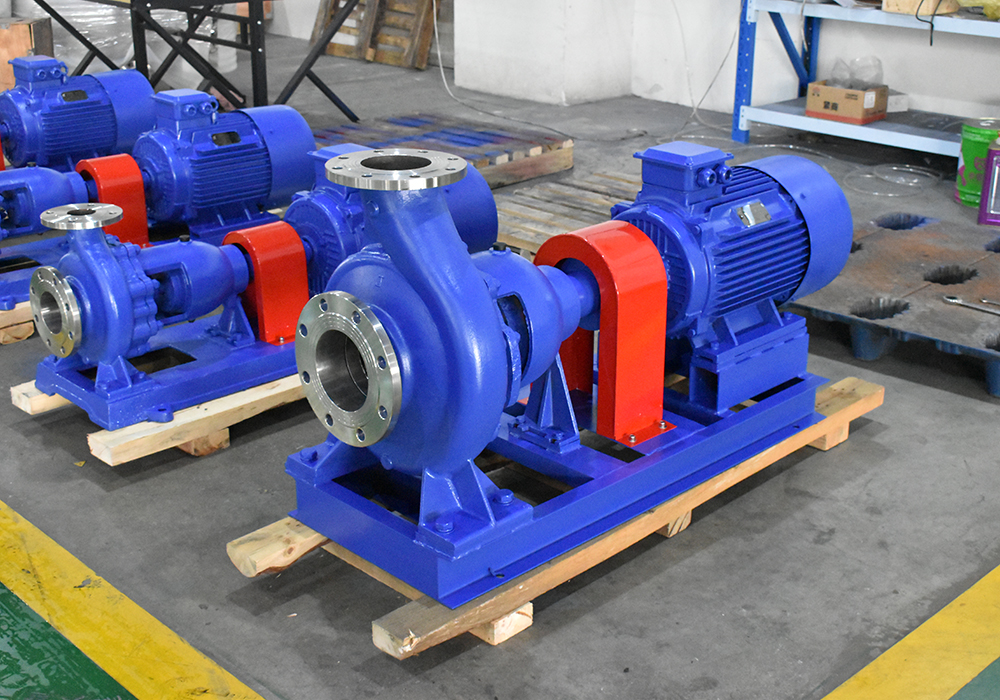
Top 5 Buy IS Types Horizontal Chemical Centrifugal Pumps Manufacturer
2026-05-26
- How to choose reliable centrifugal pumps for aggressive environments: criteria and mistakes
- TOP 5 types of horizontal centrifugal pumps: technical analysis
- Comparison table: which pump to choose for your task
- Critical errors when purchasing and installing centrifugal pumps
- Why build quality is more important than brand: a look from inside production
- Frequently Asked Questions
- Final summary and action plan
How to choose reliable centrifugal pumps for aggressive environments: criteria and mistakes
In our practice of selecting equipment for chemical production, we have repeatedly encountered a situation where the customer bought the cheapestcentrifugal pump, and after three months of operation I received depressurization of the housing and a simple line for a week. The market is oversaturated with offers, but 80% of them do not take into account the real parameters of the pumped medium - temperature, viscosity and abrasiveness. This article was written by engineers who have seen the consequences of poor choices from the inside. We'll look at the five best types of IS series horizontal pumps and similar designs available today, based on technical data rather than marketing slogans.
The choice between Chinese OEM manufacturing and European brands often comes down to a balance between budget and delivery time. Under current logistics conditions, the wait for an original pump from Europe can take 16 to 24 weeks, while trusted factories in Zhejiang province, such as Zhejiang Yangtzejiang Pumping Industry Co., Ltd., can deliver certified equipment (CE, ISO 9001) in 3 to 5 weeks. It is important to understand: the geography of production is secondary to quality control at the output. If the plant has its own testing center and tests each unit for tightness and pressure, as is done in the mentioned company with 20 years of experience, the risk of getting defective is minimal, regardless of the country of assembly.
TOP 5 types of horizontal centrifugal pumps: technical analysis
Below is a ranking based on failure analysis, cost of ownership and versatility. We don't just list models, but explain where exactly each type shows maximum efficiency.
1. Standard single stage pumps type IS (Water & Light Chemicals)
It is the workhorse of the industrial sector. The IS type design (or its modern analogues) is a cantilever single-stage unit with a mechanical seal. The main advantage is ease of maintenance and low cost of spare parts. However, many people make the mistake of trying to use standard IS versions to pump acids or alkalis without checking the wet end material.
In real projects, we recommend this category only for water, weak salt solutions and liquids with temperatures up to +80°C. The key parameter here is the material of the impeller. If you just see “cast iron” or “20 steel” on the specification, do not use that pump for chemicals. For light chemicals, AISI 304 or 316L stainless steel is required. Experience has shown that switching to 316L steel increases seal life by 40-45% in chloride applications.
Technical limitations: the maximum head usually does not exceed 125 meters, and the productivity is limited to 400 m³/h for single-stage circuits. If your requirements go beyond this, a multi-step solution will be required. The advantage is high maintainability: replacing bearings or mechanical seals takes a qualified mechanic no more than 2 hours.
Recommendation:Use this type for water supply systems, circulation in heat exchangers and pumping neutral process fluids. Before purchasing, be sure to request a Material Selection Chart from the supplier.
2. Chemical process pumps with lining (Fluorine-Lined Pumps)
When it comes to sulfuric, hydrochloric or nitric acid, metal pumps, even those made of expensive stainless steel, often cannot withstand corrosive aggression. This is where PTFE/F46 lined pumps come into play. In the product line of many leading manufacturers, including the CQB-F model from Zhejiang Yangtzejiang Pumping Industry Co., Ltd., this technology is implemented through a solid-cast lining of the flow part.
The essence of the technology is simple: the metal body carries a mechanical load, and the inner layer of plastic 3–5 mm thick protects against chemicals. This allows you to pump almost any acids and solvents at temperatures up to +150°C (depending on the grade of fluoroplastic). A beginner mistake is ignoring thermal expansion. Plastic and metal expand differently, so high-quality pumps have a special lining fastening design that prevents it from peeling off during thermal cycling.
We have recorded cases where cheap analogues lost their seal after the first heating to 100°C due to poor layer adhesion. Reliable manufacturers conduct vacuum and pressure tests at extreme temperatures before shipment. These pumps are ideal for electroplating shops, pickling lines and chemical warehouses. The only negative is that they are afraid of abrasive. Sand or solid suspensions will quickly erase the plastic layer.
Recommendation:Choose this type for clean, aggressive liquids. Make sure the supplier provides a certificate for the lining material and guarantees resistance to the specific reagent at your concentration.
3. Sealed magnetic pumps (Canned Motor / Magnetic Drive)
Leakage is a major problem with any pump with a shaft passing through the casing. Magnetic pumps solve this problem radically: the motor shaft and the pump shaft are separated by a sealed sleeve, and the torque is transmitted through a magnetic field. The range of companies with a wide profile, such as the Russian-Chinese enterprise Zhejiang Yangtzejiang Pumping Industry LLC, includes both plastic models (CQF) and reinforced stainless steel versions (ZCQ, CQB-L).
This is the only true solution for toxic, volatile or expensive liquids where the loss of even a drop is unacceptable. We observed 案例 (cases) where the introduction of magnetic pumps at the organic synthesis site reduced product losses by 98% and completely eliminated risks for personnel. However, this technology has its own “Achilles’ heel” - dry operation and pumping media with solid inclusions.
The magnetic coupling is cooled and lubricated by the pumped liquid itself. If the pump is started without liquid or if abrasive particles appear in the flow, the friction pair (usually silicon carbide or ceramic) will be destroyed in a matter of minutes. Therefore, there should always be a fine filter (at least 100 microns) in front of such a pump. It is also important to control the viscosity: for standard magnetic pumps the limit is usually 30–50 cSt.
Recommendation:Ideal for solvents, fuel mixtures and toxic reagents. Be sure to install a flow control sensor or dry-running relay in the engine control circuit.
4. Self-priming centrifugal pumps (Self-Priming Centrifugal)
In situations where the liquid level in the container is below the axis of the pump (for example, draining from tanks, pumping out from pits), conventional centrifugal pumps require the installation of a check valve and long filling with water. Self-priming modifications (type ZW or diesel units YZSP) have a built-in gas-liquid separation chamber, which allows you to lift liquid from a depth of up to 6–8 meters without pre-filling.
This category is indispensable for mobile tasks and emergency services. The design implies the presence of a special recirculation channel inside the housing. The disadvantage of this scheme is a slightly reduced efficiency compared to conventional pumps of the same size due to hydraulic losses in the separation channel. In addition, the self-priming time depends on the length of the suction pipeline: the longer the pipe, the longer the pump will “expel” air.
In our practice, there was a case when a client used a conventional pump to pump wastewater from a well, constantly encountering air pollution. Replacing with a ZW type model solved the problem instantly. It is important to remember: self-priming only works if the suction pipe is completely sealed. The slightest air leak through the threaded connection will reduce the efficiency to zero.
Recommendation:Use for filling systems, draining areas and working with containers located below floor level. Carefully check the tightness of all inlet connections.
5. Multistage horizontal pumps (Multistage Horizontal)
When high pressure is required (more than 150 meters), but the use of vertical “columns” is impossible due to restrictions on the height of the room, horizontal multistage pumps (DC series and analogues) come to the rescue. They consist of several impellers mounted in series on one shaft. The outlet pressure is summed with each stage.
Such units are critical for boiler power systems, high pressure washing (HP washing) and water injection into high-flow wells. The difficulty here lies in balancing the rotor. At high speeds (often 2900 rpm and above), any imbalance leads to rapid bearing failure. High-quality factories that have the status of high-tech enterprises use dynamic balancing of rotor assemblies, which reduces vibration to levels that allow long-term operation without repair.
A special feature of operation is sensitivity to cavitation. Since each stage increases pressure, the risk of cavitation failure of the first stage increases many times over. Strict NPSH (NPSH) control is required. We advise you to always provide a NPSH reserve of at least 0.5–1 meter above the calculated value.
Recommendation:Use for high pressure and feed water systems. Ensure stable inlet pressure and install pressure gauges upstream and downstream of the pump to monitor differential pressure.
Comparison table: which pump to choose for your task
To make your decision easier, we have summarized the main characteristics in a table. Pay attention to the “Risk” column, since it is ignoring these factors that leads to accidents.
| Pump type | Best use | Max. temperature | Abrasion resistance | Main risk |
|---|---|---|---|---|
| IS (Console) | Water, light solutions, circulation | +80°C … +120°C | Medium (depending on material) | Corrosion due to an error in choosing steel |
| Fluoroplastic | Acids, alkalis, oxidizing agents | up to +150°C | Low (plastic wears off) | Lining peeling due to overheating |
| Magnetic | Toxic, volatile, expensive liquids | up to +120°C (PTFE) | Zero (prohibited) | Dry friction pair destruction |
| Self-priming | Tanker drainage, drainage, fire systems | up to +80°C | High (special versions) | Loss of primes due to air leaks |
| Multistage | Boilers, high pressure, reverse osmosis | up to +120°C | Low (precise clearances) | First stage cavitation |
Critical errors when purchasing and installing centrifugal pumps
Even a perfectly selected pump can be killed by improper installation. Over 20 years of work in the industry, we have identified three mistakes that occur most often and cost companies millions of rubles in losses.
Mistake #1: Ignoring the NPSH.
Many engineers look only at head (H) and flow (Q), forgetting about NPSHr (required headroom). If the pressure at the pump inlet drops below the vapor pressure of the liquid, cavitation will begin. The steam bubbles collapse with enormous energy, tearing pieces of metal out of the impeller. The sound of such a pump is reminiscent of the roar of stones inside the housing. Solution: Always check the pump NPSHr with the actual NPSHa of your system. If the reserve is less than 0.5 meters, change the pipeline layout or lower the pump below the liquid level.
Mistake #2: Incorrect suction line piping.
A common picture: at the inlet of a powerful pump, an elbow is installed immediately at the flange or an eccentric adapter is used in the wrong orientation. This creates turbulence and uneven flow, which leads to radial loads on the shaft and rapid wear of the bearings. The rule is simple: before entering the pump there must be a straight section of pipe at least 5–10 pipe diameters long. Adapters must be installed so as to prevent the formation of air pockets (flat top for horizontal pipes).
Mistake #3: Saving on foundation and vibration isolation.
Heavy industrial pumps, especially diesel units or high-pressure models, create significant vibrations. Installing them directly on a concrete floor without damping pads or on a weak metal frame leads to the destruction of pipeline connections and fatigue cracks in the pump casing. We recommend using vibration isolators selected for the unit’s rotation speed and firmly fixing the pump to the frame before connecting the pipes.
Why build quality is more important than brand: a look from inside production
There is a myth in the industry that “European” automatically means “the best”. The reality is that many Western brands have long since moved production to Asia, leaving only quality control and marketing to themselves. The key question is: who controls this process and how?
For example, Zhejiang Yangzijiang Pumping Industry LLC demonstrates an approach that is becoming the standard for reliable suppliers: a full cycle from casting to final testing at its own testing site. The presence of eight production lines and our own testing center allows us to check each pump for compliance with the declared characteristics of pressure, flow and tightness before shipment. This is not just a formality. In our practice, there have been cases when batches of pumps from unknown factories showed a spread in efficiency of up to 15% of the nominal value, which on the scale of a large enterprise results in huge electricity bills.
CE and ISO 9001 certification are the basics, but a measure of reliability is the manufacturer's willingness to provide batch-specific test reports and patents on components. Technologies protected by patents, as a rule, have gone through a long process of development and are devoid of the “childhood diseases” of the first versions. Working with such integrators, who have experience working with international groups like APP or HPO, ensures that you are getting a product that can operate in a globally competitive environment, and not just hardware.
Frequently Asked Questions
What is the service life of a horizontal chemical pump?
With proper operation and materials suitable for the environment, the service life before major overhaul is 3–5 years for standard models and up to 8–10 years for pumps with improved protection. The main limiting factor is the mechanical seal, which requires replacement every 12–18 months.
Can the IS pump be used for hot water (+95°C)?
Standard IS pumps are designed for temperatures up to +80°C. For +95°C and above, it is necessary to use versions with a cooling jacket of the bearing assembly and special heat-resistant seals. Without modifications, the bearings will overheat and the shaft will jam.
What is the difference between a magnetic pump and a mechanical seal pump?
The main difference is the tightness. The magnetic pump has no moving connections between the motor and the liquid chamber, which eliminates leaks by 100%. A mechanical seal pump has a shaft running through the housing and is susceptible to micro-leakage (standardized), requiring regular replacement of the O-rings.
Is a special foundation required for IS series pumps?
Yes, required. The pump must be installed on a rigid frame fixed to a concrete foundation. This is necessary to maintain the alignment of the motor and pump shafts. Misalignment of even 0.1 mm will lead to destruction of the coupling and bearings within several weeks.
How quickly can I get replacement parts for Chinese pumps?
This depends on the availability of spare parts stock at the supplier. Vertically integrated companies such as Zhejiang Yangzijiang Pumping Industry Co.,Ltd typically keep critical components (impellers, shafts, seals) in stock, allowing parts to be shipped by air within 5-7 days. When ordering “from production”, the period may be 3-4 weeks.
Final summary and action plan
Choicecentrifugal pump- this is not just a purchase of hardware, it is an investment in the uninterrupted operation of your process. We looked at five key types of equipment, from general-purpose IS to specialized magnetic and multi-stage units. Remember: there is no “best” pump; there is only the best pump for a specific application. A mistake in choosing a material or type of construction costs more than the difference in price between a budget and a premium brand.
If you are faced with the challenge of pumping aggressive media or need a reliable solution for high pressures, do not rely blindly on catalog data. An engineering calculation is required that takes into account all the nuances of your system. A professional approach, confirmed by CE and ISO 9001 certificates and twenty years of production experience, can be offered by Zhejiang Yangtzejiang Pumping Industry LLC, providing a full cycle of support from model selection to service.
Don't risk production to save money at the procurement stage. Contact us today to receive detailed technical advice and calculate the optimal configuration of pumping equipment for your parameters.