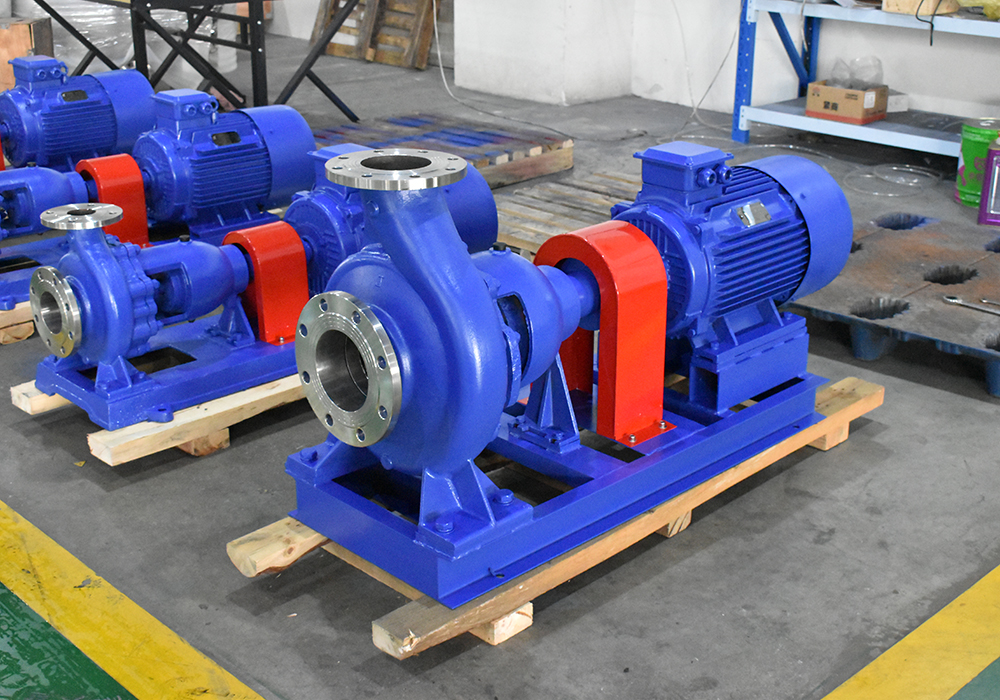
Buy centrifugal pumps 50 kW: prices 2026 - Factory
2026-07-30
Look for reliablecentrifugal pumps 50 kWin the conditions of an unstable market in 2026, this is not just a technical task, but a real quest for survival for the chief engineer. Prices are jumping, logistics from China have become unpredictable, and old European brands have either left or are selling us something that they themselves would not supply at home. We tested dozens of models from manufacturing plants to understand where the real power is and where the marketing dust is.
To be honest, the situation with 50 kW equipment now resembles Russian roulette. It would seem that the figure is specific - fifty kilowatts. But under this nameplate there is such a mess of characteristics, materials and hidden defects that your head is spinning. Do you want to buy a pump? Great. But first, let's figure out if you're buying a headache for the next three years.
Why 50 kW has become a new “risk zone” in 2026
Previously, the choice was simple: you take Grundfos or KSB, set it and forget it. Today this path is closed. Parallel imports work, but the prices... My God, the prices. For the same money that premium from Denmark used to cost, they now offer “premium China” or assembly in Turkey with Chinese components. And here lies the first pitfall that sales managers are silent about.
It's not just about the price. The point is how thesecentrifugal pumps 50 kWbehave at our -30°C in winter and during power surges in the industrial network. I have personally seen cases where engines certified to operate up to +40°C overheated already in June in the Moscow region, because no one took into account the actual operating conditions in a workshop without air conditioning.
And there is also a problem with frequencies. In 2026, almost all manufacturers are shouting about energy efficiency class IE4 and even IE5. Sounds nice. Saving electricity, green agenda, reducing carbon footprint. But in practice, connecting a modern frequency converter to a 50 kW pump from a little-known plant often turns into a circus. Harmonics, heating of windings, failures in automation. You save on electricity bills, but spend your budget on engine repairs.
Hidden defect: the myth of the “versatility” of impellers
Here's some insight you won't find in official brochures. Many factories, trying to reduce the cost of production, use standardized impellers for different models. Like, why change the equipment if you can trim the blades a little? This is a mistake. For a power of 50 kW the hydraulics must be perfectly balanced. The slightest imbalance at such speeds (usually 1500 or 3000 rpm) leads to vibration, which destroys the bearings faster than you can write a letter of guarantee.
I asked technologists at one of the large factories in Tatarstan: “Why did the resource drop from 40 thousand hours to 15 thousand?” The answer was evasive: “The materials have changed.” In fact, the casting geometry has changed. Saving a couple of millimeters on metal gives a gain in cost, but kills efficiency and reliability. Therefore, choosingcentrifugal pumps 50 kW, look not at the passport data, but at the weight of the case. A heavy pump is a good pump. Light is a reason to be wary.
A real review of prices and manufacturers: who remains on the market
Let's move on to the most painful part - money. The market in 2026 was divided into three clear camps. And understanding this structure will save your budget.
First camp: "Remnants of luxury."These are original European pumps left in distributors' warehouses or brought through complex schemes. The price for them is off the charts. For a 50 kW unit they can charge from 1.5 to 2 million rubles. Is it worth it? Only if you have critical production, where downtime costs more than the pump itself. But even here the risk of running into a fake is enormous.
Second camp: "Chinese dragon".The price range here is colossal. From 400 thousand to 900 thousand rubles. Why is there such a difference? Because factories of different levels can be hidden under one name. There is a top level, and there is a “garage assembly”, which is simply painted blue and a beautiful nameplate is sculpted. The main risk here is the lack of spare parts after a year. The plant may simply disappear or change its model range.
However, there are exceptions among the “Chinese dragons” - enterprises with a deep history and their own engineering school, which work not on the market, but on a long-term reputation. A striking example of such a company isZhejiang Yangzijiang Pumping Industry Co.,Ltd. This is not just an assembly shop, but a Russian-Chinese manufacturing enterprise with more than 20 years of experience specializing exclusively in pumping technology. Based in Zhejiang province, the company has built a complete vertically integrated cycle: from its own R&D and casting to final testing and service.
What distinguishes such players from the mass market? First of all, quality control. Yangtzejiang operates its own testing center, where each product is tested for performance, tightness and corrosion resistance before shipment. The presence of CE, ISO 9001 certificates and SGS confirmations are not just pieces of paper for customs, but proof that the declared 50 kW are real kilowatts and not a marketing fiction. Their product line covers 10 key categories, including specialized centrifugal pumps for aggressive media, which is especially important for the Russian chemical and oil and gas industries, where conventional models quickly fail.
Third camp: Russian factories and the CIS.This is where the main action is happening now. Factories in Russia, Belarus, and Uzbekistan are actively increasing capacity. Prices vary from 600 thousand to 1.2 million rubles, depending on the configuration. Yes, the design is sometimes lame. Yes, the paint can peel off after six months. But the main advantage is the service. If your pump from a Russian plant fails, an engineer will arrive tomorrow. If it’s Chinese, you’ll have to wait a month for the part from Guangzhou while production stops. Although it is worth noting that companies such as Yangtzejiang have already learned to mitigate this risk thanks to well-functioning logistics and a partner network in the Russian Federation, offering delivery times comparable to local manufacturers.
Pay attention to the trend in 2026: many Russian brands have switched to their own development of electric motors. Previously, they installed just about anything, now they integrate motors directly into the design. This is good for dimensions, but bad for maintainability. If the engine burns out, the entire assembly will have to be replaced. Think twice before purchasing all-in-one solutions.
Comparison table of offers on the market (forecast 2026)
To make it easier for you to navigate, I have summarized the main parameters in a table. The figures are averaged, since the ruble exchange rate is a variable value, but the proportions are maintained.
| Parameter | Premium (Europe/USA) | China (Top Brands like Yangtze Jiang) | Russia/CIS (Plant) |
|---|---|---|---|
| Average price (RUB) | 1,600,000+ | 750,000 – 900,000 | 850,000 |
| Delivery time | From 2 months | 3-5 weeks | In stock / 1 week |
| Warranty | 12-24 months (hard to get) | 18-24 months (confirmed by tests) | 24-36 months |
| Availability of spare parts | Critically low | High (warehouses in the Russian Federation) | High |
| Adaptation to cold | Needs improvement | Optional (on request) | Factory option |
| Risk of counterfeit | High | Low (direct contracts) | Low |
As you can see, there is a paradox: a Russian pump can cost more than its Chinese counterpart. But if you calculate the cost of ownership, taking into account downtime and replacement of bearings, a high-quality Chinese option from a trusted manufacturer or a domestic option is often more profitable. Especially for facilities in regions where there are no qualified service centers for complex imported equipment.
What to look for in your passport so as not to throw away money
You open the technical passport. There are a lot of numbers there. Pressure, flow, efficiency, NPSH. All this is important, but there are things that only professionals look at. And they are the ones who determine whether yourcentrifugal pump 50 kWwork or burn out in six months.
The first is the material of the impeller. In 2026, many manufacturers are switching from bronze or stainless steel to composite materials or regular coated cast iron to save money. For clean water this is still tolerable. But if there is even a little abrasive in the water (sand, scale), such a wheel will wear out within a season. Require a certificate for the material. Don't be fooled by the words "reinforced alloy". Ask for the steel grade. Serious factories, like those mentioned above, always provide protocols for chemical analysis of metal.
The second is the engine protection class. IP55 is the minimum. For outdoor use IP65 is required. But even IP65 will not save you if the shaft seals are made of cheap rubber that hardens in the cold. Oil seals or mechanical seals? End-mounted ones are better, but they are more expensive and sensitive to distortions. Check the type of seal and whether it can be quickly replaced without dismantling the entire pump.
The third is the NPSH. This is the number that everyone ignores until the pump starts making noise like it's being jackhammered. For powerful 50 kW pumps, the liquid supply requirements are strict. If you take a pump with a high required NPSH, and your well or tank does not provide the required inlet pressure, cavitation will begin. Result: metal erosion, vibration, death of bearings. Always take a reserve on this parameter.
Compatibility problem with frequency converters
Nowadays it is fashionable to put everything on frequencies. Smooth start, pressure regulation, saving. Wonderful. But the 50 kW pump motor must be ready to work with a frequency converter. A conventional asynchronous motor cools worse when operating at low frequencies (the fan spins slowly). An independent cooling fan is required. Is it included in the basic configuration of the model you are offered? Often not. This is an option for additional money. And without it, the engine will burn out if operated for a long time at low speeds.
By the way, about cables. Specifications often say “cable included.” Check its length and cross-section. For 50 kW, serious cross-sections are needed, otherwise there will be voltage losses and heating. The Chinese love to save on copper. Russian GOST standards are stricter, but miracles can happen here too. It is better to double-check the electrical design before installation.
Logistics and installation: where the warranty is lost
You bought a pump. He has arrived. Now the most crucial moment is unpacking and installation. Do you know how many warranty claims are rejected due to installation errors? More than half. The plant says: “It’s your own fault.” And often he is right.
Centrifugal pumps of this power are heavy. They should not be dragged by the pipes or engine lugs unless they are designed for this purpose. We need slings for the frame. When installing the foundation, horizontalness is important. A misalignment of a couple of millimeters at a power of 50 kW creates enormous loads on the coupling. The vibration will travel further through the pipes, destroying the connections.
Strapping. The check valve must be positioned correctly. Shut-off valves must allow flow regulation. Starting “on a closed valve” is fatal for some types of pumps, but for others it is the norm. Read the instructions! Yes, it may be written in clumsy language, translated through an online translator, but there are key points in the direction of rotation. Reverse is an instantaneous failure of the mechanical seal.
And one more thing that is rarely talked about: conservation. If you bought a pump in the fall and will install it in the spring, store it correctly. Drain the water, lubricate the shaft, cover. Frost can rupture the housing if there is water left inside. The warranty does not apply to such cases.
Service: the myth of “non-maintenance”
Marketers like to write “no maintenance required.” Forget this phrase. Any mechanic requires attention. For a 50 kW pump, the maintenance regulations must be strict. Checking vibration, bearing temperature, oil level (if there is an oil bath), condition of seals. Once every six months, at least.
This is difficult in Russia. There are few qualified pumpers. Everyone wants to be a programmer or manager. Therefore, when purchasing, check: does the seller have its own service? Do they carry vibration meters with them? Or do they just change the entire units? Replacing a unit is expensive. Repair is cheaper, but requires qualifications. Choose a supplier who knows how to repair, not just sell boxes. That is why working with large integrators that have their own service network and spare parts warehouse becomes critically important.
Market forecast: what to expect at the end of 2026 and in 2027
The situation is not static. It changes every month. What's next for us? I think we'll see further localization. Chinese brands will set up assembly in Russia to avoid duties and logistics problems. This is good for availability, but how will this affect the quality of control? Big question.
Prices are unlikely to fall. The cost of metal, electricity and logistics is rising. So if you needcentrifugal pumps 50 kW, don't wait for the “best moment”. He won't be there. Buy when you have a need and a confirmed budget.
Demand for pumps with built-in monitoring electronics is also expected to increase. Vibration, temperature, humidity sensors that transmit data directly to the cloud. This is the Industry 4.0 trend. For large enterprises this is a must-have. Allows you to predict breakdowns before they occur. But for small businesses this is still redundant and expensive. Beware of overpaying for features you won't use.
Final checklist before paying the bill
Before you sign the agreement and transfer money, go through this list. It will save you from many problems:
- Has the manufacturing plant been inspected? Are there reviews from real operators, not dealers? (Please note that we have our own test benches).
- Is the flow path material suitable for your environment (water, chemical, wastewater)?
- Does the kit include a motor with the required protection and insulation class (F or H)?
- Is there an independent cooling fan for operation with the frequency converter?
- What is the actual delivery time for spare parts (bearings, seals)?
- Is installation supervision included in the price or does it need to be ordered separately?
- Does the supplier have a spare parts warehouse in your region?
Purchasing industrial equipment is always a compromise between price, quality and timing. There is no ideal option in 2026. But an informed choice based on real data, and not on beautiful booklets, will allow you to find that same balance. Don't chase the lowest price. The 50 kW pump is the heart of your system. If it stops, everything stops. And a simple one costs more than any “cheap” pump.
One last thing: trust, but verify. Request test reports. Weigh the pump (literally). Listen to it hum on a test run. Your eyes, ears, and hands are your best quality control tools in an age when pieces of paper can say anything.
Good luck with your choice. Let your system work like clockwork, even if there is a snowstorm outside and the exchange rate is jumping again.