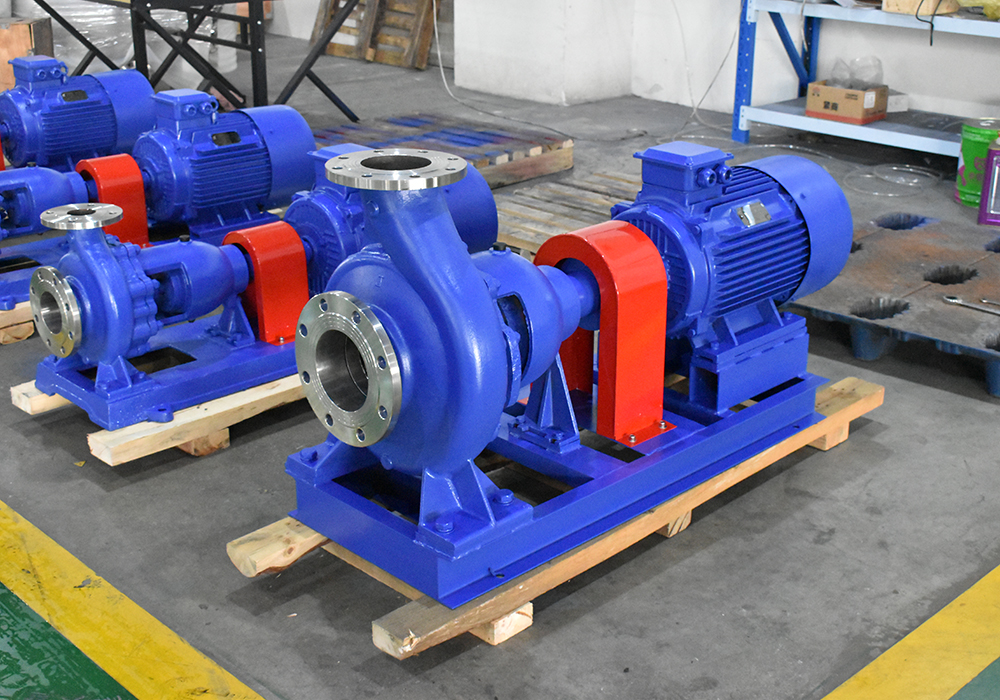
Use of centrifugal pump 1 kW plant in domestic systems
2026-05-31
- Why a 1 kW centrifugal pump is not just a “small motor” for household systems
- Technical nuances: what does the nameplate power of 1 kW hide?
- Comparison of design types: which centrifugal pump to choose for your home
- Production Standards and Reliability: Experience of Zhejiang Yangzijiang Pumping Industry Co.,Ltd
- Frequently Asked Questions
- Practical recommendations for installation and maintenance
- Conclusion: an investment in comfort and stability
Why a 1 kW centrifugal pump is not just a “small motor” for household systems
In our practice of selecting equipment, we often encounter a misconception: customers believe that a power of 1 kW automatically makescentrifugal pumpsa universal solution for any private home or cottage. This is a dangerous oversimplification. Engine power is only one of the parameters, and not always decisive. The actual efficiency of the system depends on how that kilowatt is converted into head and performance at the specific hydraulic resistances of your network. If you ignore the pump curve, you risk getting a device that either overheats after a month or simply does not lift water to the second floor.
When it comes to domestic water supply, heating or irrigation systems, choosing a unit with a power of around 1 kW (usually a range from 0.75 to 1.1 kW) requires careful analysis. Unlike industrial giants, here every watt counts, and errors in calculations do not lead to a shutdown of the workshop, but to a lack of water in the shower or defrosting of pipes in winter. We analyzed hundreds of cases of equipment failure in the private sector and found out that 60% of problems are not related to a defective plant, but to a mismatch between the type of pump and the real task.
Technical nuances: what does the nameplate power of 1 kW hide?
The number “1 kW” on the engine nameplate only tells you about electricity consumption, but does not tell you anything about how many cubic meters of water the device will pump and to what height it will raise it. For householdcentrifugal pumpsThe ratio of head (H) and flow (Q) is critical. An engine of the same power can be installed on a pump with different impeller diameters and different flow path geometries. In one case, you will get high pressure (up to 40-50 meters) at low flow rates, which is ideal for wells more than 20 meters deep. In the other, there is a high flow rate at low pressure, which is suitable for filling swimming pools or watering the garden from an open container.
One of our clients in the Leningrad region was faced with a situation where a new 1 kW pump was constantly turned off by a thermal relay. Upon inspection, it turned out that it was installed on a heating system with high hydraulic resistance due to the large number of radiators and narrow pipes. The pump worked at a point far from its efficiency, the motor was overloaded, although the current formally did not exceed the nominal value. We replaced it with a model with a different impeller rating and the problem went away. This case shows: you need to look not at kilowatts, but at the operating point in the product data sheet.
It is also important to consider the type of liquid. Standard household models are designed for clean water with temperatures up to +35…+40°C. If you plan to use such a unit to pump coolant in a heating system or hot water from a boiler, the standard shaft seal may not hold up. This requires special designs with heat-resistant seals or mechanical seals. Ignoring this factor leads to leaks already in the first season of operation.
Comparison of design types: which centrifugal pump to choose for your home
There are many modifications on the market, and the choice between them often causes confusion for the unprepared buyer. To make the right decision, you need to clearly understand the difference in design and purpose. Below is a comparison of the main types of pumps with a power of about 1 kW, which are most often used in private construction.
| Pump type | Operating principle and features | Ideal use cases | Basic restrictions |
|---|---|---|---|
| Self-priming surface | Installed above water level. Capable of lifting water from a depth of up to 8 meters by creating a vacuum. Often equipped with an ejector. | Irrigation from a well, water supply from a shallow well, increasing pressure in the main line. | Noisy operation, sensitivity to the presence of air in the system, limitation in suction depth. |
| Multistage centrifugal | Several impellers successively increase the pressure. Compact body, low noise level. | Autonomous water supply systems from wells up to 30-40 m deep, boiler installations. | Requires clean water (sand quickly damages steps), difficulty in repairing in the field. |
| Console monoblock | Classic design with one impeller on the motor shaft. Simple design, maintainability. | Pumping large volumes of water from reservoirs, circulation in heating systems of large houses. | Low pressure compared to multi-stage analogues of the same power, takes up more space. |
| Vertical multistage (type CQB-L) | Compact vertical design. Saves space indoors. High pressure at low flow. | Water supply to high-rise cottages, fire extinguishing systems, industrial bottling lines. | Requires strictly vertical installation and is sensitive to foundation distortions. |
When choosing a specific model, you should pay attention to the materials of the flow part. For domestic water, high-quality cast iron or AISI 304 stainless steel is sufficient. However, if the water is highly acidic or contains aggressive impurities, it is advisable to consider options with polymer coatings or full plastic design, as, for example, in the CQF line of plastic magnetic pumps, which, although they are an industrial solution, are sometimes used in difficult domestic conditions for chemically active environments.
We recommend that you make a simple hydraulic calculation before purchasing: measure the depth of the water surface, the distance to the water point and the number of taps open at the same time. This data will allow the seller to select a model that will work in the zone of maximum efficiency, and not at the limit of its capabilities.
Production Standards and Reliability: Experience of Zhejiang Yangzijiang Pumping Industry Co.,Ltd
The reliability of pumping equipment is laid down at the design and casting stage of the casing. In our company,Zhejiang Yangzijiang Pumping Industry Co.,Ltd, we pay special attention to the rotor balance and the quality of the impellers. Even for small 1kW household models, an imbalance can lead to vibration that will destroy the bearings within a few months. Our own testing center checks each batch for compliance with the declared pressure and tightness characteristics, which minimizes the risk of defects reaching the end user.
More than 20 years of experience in the development of industrial pumps allows us to apply technologies previously available only to heavy industries in the household equipment segment. For example, the use of magnetic couplings in some models (as in the ZCQ series) completely eliminates leakage through the shaft, which is a critical advantage for systems where any drop of water on the floor is unacceptable. Although our main specialization is pumping aggressive and abrasive liquids for factories, we transfer the principles of corrosion resistance and durability to products for the civil sector.
It is important to note that the production is equipped with eight complete lines, which ensures quality control at every stage: from incoming metal inspection to final assembly. The presence of CE and ISO 9001 certificates is not just paperwork for customs, but confirmation that processes are standardized. When you buy a pump manufactured at such a facility, you are getting a predictable lifespan, not a lottery ticket.
Frequently Asked Questions
Is it possible to use a 1 kW industrial centrifugal pump in a private home?
Yes, you can, and often it is even more profitable. Industrial models, such as horizontal multistage pumps of the DC series or self-priming ZW, have a large margin of safety. They are designed for round-the-clock operation in difficult conditions, so in the gentle mode of a private home their service life can exceed 10-15 years. The main thing is to choose the right model in terms of pressure and flow rate so that it does not work at a dead end.
How to protect the pump from dry running?
Dry running is the main cause of failure of seals and impellers. The most reliable protection is to install a pressure switch with a dry-running protection function or a separate float level sensor. In some modern models, the built-in electronics already include this function. Don't rely on your attention alone: the water level at the source may drop unnoticed at night.
What is the service life of a 1 kW centrifugal pump?
Subject to proper operation, clean water and timely replacement of bearings (every 3-5 years), a high-quality pump will last from 7 to 12 years. High-level Chinese manufacturers, such as our enterprise, working with the international groups APP and DALI, provide a resource comparable to European brands, but at a more affordable price thanks to the optimization of logistics and production.
Is it necessary to preserve the pump for the winter?
If the pump is used only for irrigation and is installed outdoors or in an unheated room, it is a must. Water inside the housing will expand when it freezes and rupture the cast iron or aluminum housing. It is necessary to drain all the water through a special drain hole. If the pump is located in a warm boiler room and operates year-round, preservation is not required.
Practical recommendations for installation and maintenance
Even the most advanced pump will fail quickly if it is not installed correctly. Here are a few rules that we strongly recommend following:
- Foundation and vibration isolation.The pump must stand on a flat, hard surface. Use rubber vibration mounts under the engine feet. This will reduce noise and prevent vibration from damaging threaded connections.
- Protection from dirt.Be sure to install a coarse filter (mesh) on the suction pipe. If a stone or scale gets into the impeller of a centrifugal pump, it instantly disrupts the balancing and leads to shaft runout.
- Check valve.Install a check valve at the pump outlet (or at the end of the suction pipe for surface models). This will keep water in the system and prevent water hammer when restarting.
- Electrical safety.The connection must be made through a circuit breaker with the correct current rating. Grounding the housing is mandatory, especially for wet rooms.
Regular maintenance does not require complex tools. Once every six months, check the tightness of the bolts, the absence of extraneous noise and the temperature of the housing. If the pump begins to heat up more than usual, this is the first signal about a problem with the bearings or a clogged impeller.
Conclusion: an investment in comfort and stability
Choicecentrifugal pumpwith a power of 1 kW for domestic needs is a task that requires an engineering approach, and not just buying the first box you come across in a store. Understanding the differences between design types, taking into account the characteristics of your hydraulic system and paying attention to quality workmanship will guarantee you years of trouble-free operation. Products developed taking into account many years of experience of companies such asZhejiang Yangzijiang Pumping Industry Co.,Ltd, combines the reliability of industrial standards and adaptability for specific tasks.
Do not skimp on the quality of the equipment, because the cost of replacing a pump and eliminating the consequences of a leak is many times higher than the difference in price between a cheap analogue and a proven brand. We are ready to help you find the optimal solution, be it a simple irrigation system or a complex heating circuit.
If you still have questions about choosing a model or need technical advice on integrating the pump into your system,contact our engineers today. We will provide you with equipment that actually works, and doesn't just spin.