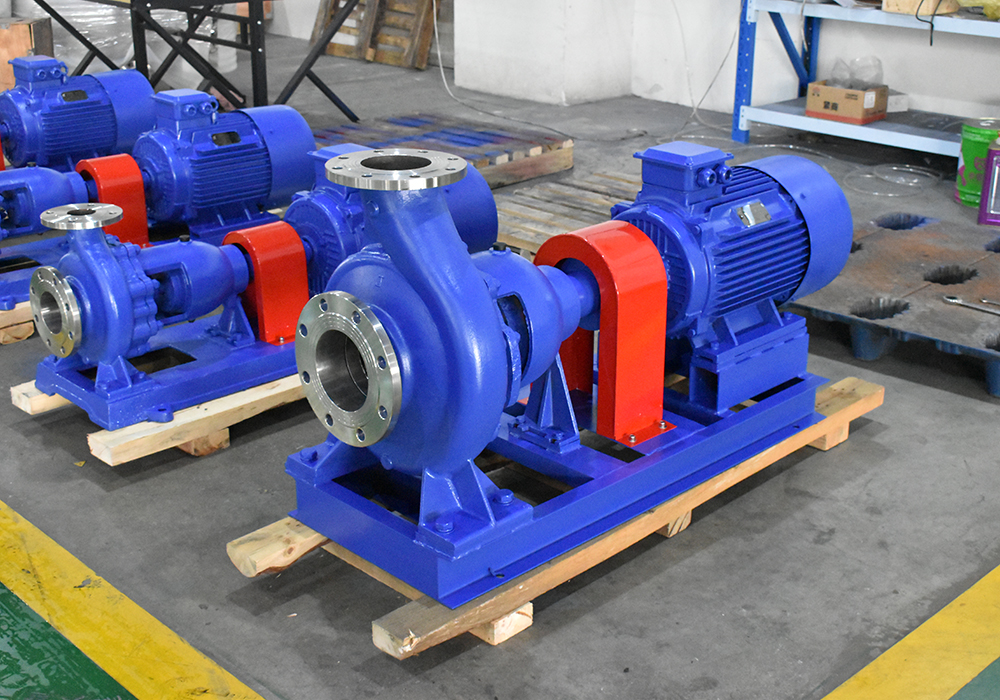
Where to find a reliable China wholesale centrifugal pump 40 m3 h Manufacturer?
2026-06-04
- Where to look for a reliable supplier of 40 m³/h centrifugal pumps: direct answer
- Technical nuances of selecting a centrifugal pump for 40 m³/h
- Risks of importing pumping equipment from China and how to avoid them
- Why vertical integration of production is important for the buyer
- Certification and standards: what to look for in documents
- Practical experience: implementation cases and typical mistakes
- Frequently Asked Questions
Where to look for a reliable supplier of 40 m³/h centrifugal pumps: direct answer
If you needcentrifugal pumpwith a capacity of 40 m³/h from a Chinese manufacturer, look for a factory with its own test facility and ISO 9001/CE certificates, not a reseller. In our experience in purchasing industrial equipment, we have seen companies lose up to 30% of their budget due to choosing suppliers who simply resold equipment without technical support. A reliable partner should provide performance curves (Q-H) specific to your point of operation, rather than generic catalogs. For a volume of 40 cubic meters per hour, the selection of the material of the flow part for a specific environment is critical - be it clean water or aggressive chemicals.
We recommend immediately requesting a hydraulic test report from the factory for a specific batch. This eliminates 80% of unreliable manufacturers who cannot confirm the stated parameters. The Chinese market is oversaturated with proposals, but only a few enterprises, such as Zhejiang Yangtzejiang Pumping Industry LLC, combine the full cycle from R&D to final testing of each product in its own center, ensuring compliance with real operating conditions.
Technical nuances of selecting a centrifugal pump for 40 m³/h
A capacity of 40 m³/h (equivalent to approximately 666 liters per minute) is a borderline parameter located between the household segment and heavy industry. A mistake in choosing the type of impeller is costly here. If you are pumping water with suspended solids, a standard closed impeller will quickly fail due to abrasive wear. In such cases, we insist on using open or semi-open impellers, even if their efficiency is 3-5% lower. Durability in dirty environments is more important than energy savings.
When working with chemically active liquids, the material of the housing and seals becomes a key factor. 304 stainless steel may not cope with some acids at elevated temperatures. This requires either 316L stainless steel or a PTFE liner. The company offers lined models such as the CQB-F magnetic pumps, which are ideal for harsh environments without the risk of leaks due to the absence of seals. Ignoring the chemical compatibility of materials leads to through corrosion of the housing after just 6 months of operation.
Another hidden parameter is the NPSH. For a flow of 40 m³/h, the liquid entry speed into the pump increases. If the suction lift is not calculated correctly, cavitation will occur and destroy the impeller in a matter of weeks. We often see projects where the pump is loud and vibrates precisely because this parameter was ignored at the system design stage. Always ask your supplier to calculate the allowable suction lift for your specific fluid temperature.
Comparison of construction types for the 40 m³/h task
| Comparison parameter | Cantilever centrifugal pump | Vertical multistage pump | Self-priming pump |
|---|---|---|---|
| Optimal pressure | Up to 50 meters | From 50 to 150+ meters | Up to 40-50 meters (including suction) |
| Application | Water supply, circulation, moderate pressure | Boiler feed, high-altitude feed, reverse osmosis | Water intake from open sources, drainage |
| Risk of cavitation | Medium (requires flooded suction) | High (sensitive to inlet air) | Low (structurally protected) |
| Maintenance cost | Low (simple design) | High (many stages and seals) | Average (wear of working suction parts) |
The choice between these types depends not only on the pressure, but also on the installation conditions. Vertical pumps save space but require complex motor maintenance from above. Cantilever pumps are easier to repair, but take up a larger area. For tasks where compactness and high pressure at a flow rate of 40 m³/h are important, horizontal multistage pumps of the DC series become the optimal solution, ensuring stable operation in boiler feed and pressure booster systems.
Risks of importing pumping equipment from China and how to avoid them
The main problem when ordering equipment from China is the discrepancy between the actual performance stated in the catalog. Many small factories test pumps on water under ideal conditions, without taking into account the actual losses in the pipeline. As a result, you get a unit that, instead of 40 m³/h, produces 32-35 m³/h under load. To avoid this, request a test report indicating the voltage, frequency, and viscosity of the test fluid. The absence of such a document is a red flag.
The second common mistake is saving on the engine. The supplier may supply an IE1 energy efficiency motor instead of the required IE3, which will increase your energy costs by 15-20% over its lifetime. In addition, cheap motors often have IP44 protection instead of IP55, which is unacceptable for wet industrial environments. We strongly recommend that the specific brand of engine or requirements for insulation and protection class be specified in the contract.
The third risk is logistics and packaging. Centrifugal pumps weighing over 50 kg are sensitive to shock during transportation. Weak wood lathing leads to deformation of the shafts or cracks in the cast iron housing. Check the packaging photo before shipping: the pump must be firmly fixed and the flanges closed with plugs. Also make sure that the oil from the crankcase is drained before shipping to avoid leaks and damage to the container.
Why vertical integration of production is important for the buyer
When you buy a pump from a trading company, you don't know who actually made it or what materials were used. Full-cycle factories such as Zhejiang Yangzijiang Pumping Industry Co., Ltd. control every step, from casting housings to balancing rotors. Having eight in-house production lines allows us to respond flexibly to orders and guarantee deadlines. This is especially important for non-standard projects, which require adaptation of the basic model to the specific conditions of the customer.
Having your own testing center is not just a marketing ploy, but a necessity for quality control. At the enterprise, each batch is tested for leaks, pressure and vibration. This allows assembly defects to be identified before shipment to the customer. The status of a provincial high-tech enterprise confirms the presence of patents for design solutions, which indicates the ability of engineers to solve complex problems, and not just copy other people's drawings.
Working with an integrated manufacturer gives you access to deep technical expertise. Plant engineers may suggest changing seal material or changing impeller geometry to optimize performance in your system. This level of service is not available from distributors, who are limited by the range of stock items. Long-term partnerships are built on transparency and the ability to get a custom solution, not a generic box off the shelf.
Certification and standards: what to look for in documents
To work in Russia and the EAEU countries, having a TR CU certificate of conformity is mandatory. However, international standards are also important for export supplies. The CE certificate confirms the safety of the equipment for the European market, and ISO 9001 guarantees the stability of the quality management system at the plant. Document verification by an SGS inspection company adds a layer of confidence by confirming that the product actually meets its stated specifications.
Pay attention to the pump design standards. For example, the design according to GOST 15150 determines the climatic operating conditions. If the pump is intended to operate outdoors in Siberia, the conventional version will not work - a northern version with frost-resistant materials and heated bearing units will be required. Ignoring the climatic factor leads to equipment failure in the first winter season.
It is also important to check the compliance of the electrical parameters. Motors must be designed for the voltage and frequency of your network (for example, 380V/50Hz). A discrepancy between these parameters will lead to overheating of the windings and rapid failure of the motor. A qualified supplier will always clarify these details before production begins to eliminate the risk of equipment incompatibility with your infrastructure.
Practical experience: implementation cases and typical mistakes
One of our clients, a food industry enterprise, was faced with the problem of frequent pump breakdowns when pumping syrup. Initially, they used standard centrifugal pumps, which could not cope with the high viscosity of the product. After auditing the system, we recommended switching to GF type sanitary screw pumps. This solution made it possible to increase the service life of the equipment by 3 times and reduce energy consumption due to a smoother supply of the product without pulsations.
In another case, at a chemical plant, there was a problem with toxic reagents leaking through the stuffing box seals. Replacing conventional pumps with magnetic pumps of the CQB-L series completely solved the problem of tightness. The absence of moving seals eliminated the risk of harmful substances entering the environment and ensured the safety of personnel. This example shows that the correct choice of pump type can solve not only technical, but also environmental problems.
A common installation mistake is the absence of check valves on the pressure line. When the pump stops, the liquid drains back, causing water hammer and rotation of the shaft in the opposite direction. This leads to destruction of bearings and mechanical seals. Installing a simple check valve costs a penny, but saves expensive equipment from premature failure. Always check the harness design for the required safety features.
Frequently Asked Questions
What is the minimum order quantity (MOQ) for centrifugal pumps?
For standard models, most factories are ready to ship from 1 piece, but the price will be higher than the wholesale price. To get the best price and delivery conditions, it is recommended to order from 5-10 units or form a groupage container. Individual projects made to order may have their own conditions for a minimum batch, which are discussed separately with the plant engineer.
How long does it take to produce and deliver a pump to Russia?
The standard production time is 15-25 working days after confirmation of the order and receipt of advance payment. Delivery by road takes another 10-15 days, by rail - about 20-30 days. Thus, the total delivery cycle usually falls within 1.5-2 months. Urgent orders can be fulfilled faster due to priority release into production.
Is there a guarantee and how is the service provided?
The standard warranty for industrial pumps is 12 months from the date of commissioning or 18 months from the date of shipment. The manufacturer provides spare parts and technical support remotely. For large projects, it is possible to conclude service contracts with on-site specialists. Having a dealer stock of spare parts in your area speeds up the repair process in the event of a breakdown.
Is it possible to order a pump with non-standard characteristics?
Yes, full-cycle factories such as Zhejiang Yangzijiang Pumping Industry Co., Ltd. offer customization services. You can change the fluid end material, seal type, shaft length or motor parameters to suit your needs. To do this, you must provide a technical specification, which will be reviewed by the engineers of the design bureau.
Finding a reliable supply partnercentrifugal pumpsrequires careful analysis of not only the price, but also the technical capabilities of the manufacturer. Choose companies with proven experience, their own testing base and a transparent quality control system. This is an investment in the smooth operation of your production for years to come. Don’t take risks by trusting dubious intermediaries - work directly with trusted factories.
Are you ready to discuss your project and select the optimal pumping equipment?Contact us todayto receive technical advice and commercial proposals. We will help you find a solution that is ideal for your liquid transfer needs.